Wednesday, December 21, 2005

Tunes: Learning to Polka

A few weeks back my teacher said I should learn a new tune, but that I should pick something other than a jig since my current repertoire leans heavily towards jigs. After considering a number of reels, I chose John Ryan's Polka, mostly because I didn't really get polkas.

I have a hard time recognizing polkas, much less playing them right. The 2/4 time signature sounds a lot like the 2/2 of a reel, especially if they're not articulated carefully. But my teacher pointed out an important difference between the reel and the Irish polka. The polka, he said, is the only type of tune in Irish music which has a backbeat, although I'm pretty sure he meant an emphasis on the half-beats rather than the second (last) beat in each measure. He told me that he played polkas "incorrectly" for ten years before someone told him about this.

Armed with this information I was able to go back and listen to track 5 of Mary Bergin's Feadóga Stáin 2 a bit more carefully and I can get a sense of what he means.

But it will be a good while before I can play polkas like she can.

Have a suggestion for a great polka recording? Leave a comment!

Tuesday, December 13, 2005

WWW: Remembering a Kwela Master

Kwela is a genre of music created in South Africa in the 1950s, and characterized by an upbeat, jazzy pennywhistle lead. The name is a Zulu word for "get up," and the police vans which patrolled South African townships during the Apartheid era were slangily known as "kwela kwela vans." It seems that folks who ran illegal gambling games on the streets of the townships sometimes used kwela bands as cover or as lookouts:

Dice rattle, streetwise young voices call bets and argue, the dice stop rolling, cheers and groans as the coins are scooped up again.

Feet come running and an urgent voice calls: "E Bops, kom maak gou -- hier kom die kwela kwela van!" ("Hurry up, here comes the police van"). "Tom Hark" has been watching for police at the corner.

Dice and cash vanish, out come pennywhistles and guitars, and the gambling school becomes a kwela band (the music named after the police van) and they swing into the irresistible tune of Tom Hark. The police rumble past in their van.

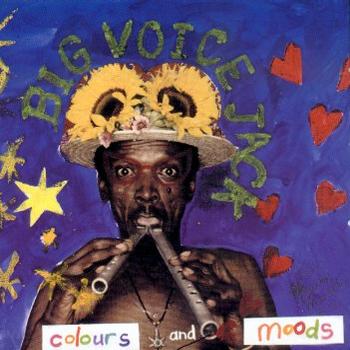
Aaron "Big Voice Jack" Lerole was "discovered" by a record company scout playing his pennywhistle in the street with his brother. They recorded a record the same day which eventually sold around five million copies. Six months later he was sold into slavery by the South African police. He was beaten by the farmer who had purchased him, which permanently lowered his voice, resulting in his nickname in later life. He escaped slavery after the intervention of an activist lawyer, resumed music performance, went on to tour Europe and Africa.

The kwela scene in South Africa essentially died when Spokes Mashiyane, one of its chief exponents, took up the saxophone. The kwela sound fused with Marabi, another indigenous South African music, forming mbaqanga. But Big Voice Jack continued to play Kwela, and made a comeback of sorts in the 1990s when South African-born Dave Matthews heard him play at the Bassline Jazz club:

However, it was at The Bassline Jazz Club in Melville Johannesburg that Jack's finest moment was set in motion. Jack was playing at the club and Dave Mathews, guitarist, songwriter and singer with the internationally acclaimed Dave Mathews Band, was in the audience. Dave's saxophonist had asked him to pick up a few pennywhistles while he was visiting South Africa and Dave approached Big Voice Jack after the gig to ask him where he could find them. Big Voice Jack decided to rather give his own whistles to Mathews. "I thought that I would never play in a big stadium in America, so I wanted my whistles to be there," says Jack. "So I gave them to him."

Big Voice Jack's generosity was repaid when the Dave Mathews Band invited him to come over to the States and play two gigs with them at the Foxboro stadium in Boston and the Giants stadium in New York. This invitation from arguably the hottest rock act in America at the moment is a fitting tribute to the lasting contribution that Big Voice Jack has made to South African music, and went down a treat. Jack's gigs with the Dave Mathews Band were recorded in a documentary by South African filmmaker Johnathan Dorfman called "Back to Alexandra." The film shows Jack on stage before an 88,000 strong crowd, jiving and jamming with the band like a man half his age. He went down so well that the band even asked him to play one of his own tunes, "Back to Alexandra," a song in which Jack gives vent to his lifelong hatred for guns.

Big Voice Jack died of throat cancer in 2003. You can buy his CDs through South Africa's One World or Amazon or Stern's Music. The latter has M3U audio samples!

Thanks especially to Keith Addison for publishing much of the linked material.

Update: Here's an MP3 of Tom Hark.

Saturday, December 10, 2005

WWW: Free Irish Music Download Blog

This site has been around for some time, but it's new to me. It links MP3s posted by various bands — mostly smaller groups — and includes a short blurb about each band and information on where to buy their CDs if you like what you hear. All linked downloads are legal.

For some reason they don't link their Atom feed, but it's here if you'd like to subscribe.

Wednesday, December 07, 2005

Recordings: The Chieftains / Live from Dublin

This will be a somewhat unusual record review.

First things first: I like The Chieftains. They're a great band and seem to be fine people. "Live from Dublin" is a tribute to Derek Bell, their long-time harpist and all-around interesting guy. But I'm not going to buy it, because their record label, Sony, chose to include software which is not beneficial to people who legally own the CD, behaves like spyware and is dangerous to your computer.

According to Sony and the Electronic Frontier Foundation, the software contains a defect which could allow malicious software to gain control over your computer. A similar piece of malware delivered on other Sony CDs in the name of copy protection was in fact exploited by virus writers.

According to Edward Felton, the software:

  1. Installs without meaningful consent or notification, even if you decline the license agreement
  2. Includes either no uninstaller or an uninstaller that fails to remove major components of the software
  3. Transmits information about you to SunnComm, the developer of the software, without notification or consent

If you already own this CD, don't put it in your computer. It is safe to put it in an audio-only CD player, however. If you have already put the CD into your computer then you may want to remove the Sony/SunnComm software from your computer. Don't use the so-called "uninstaller" included with the CD; like the uninstaller for Sony's other "content protection" system, it's as dangerous as software itself. However, the uninstaller linked on the EFF page has (at least temporarily) disappeared from SunnComm's site, and when you search SunnComm's site for an uninstaller, they try to talk you into updating the software instead. Unfortunately, there is little reason to believe that the problems disclosed thus far are the only problems with the software. [Update: Well, that didn't take long. A new problem in the patched version was announced while I was typing the original version of this post!] When a record label appears to presume that their customers are criminals, why would they worry about their customer's security? Why would I want to run software on my computer which does nothing for me? The EFF is suing Sony over this.

Think this doesn't apply to you if you have a Mac? I wouldn't count on it.

Sony would like to sell me a laptop. But given that they try to install this software and other software which is even worse on computers which they don't produce, why would I trust them not to put such malware on a computer they produce themselves?

I have no reason to believe The Chieftains have anything to do with this software being on their CD. I presume, based on what I know about how the record industry works, that the decision to include it was made by the record label alone.

Sunday, December 04, 2005

Practice: Hitting the High (Up) Notes

I was in Santa Fe, NM, a week ago for my brother's wedding, so while there I tried, without any luck, to find a session to sit in with. The closest thing I found was Celtic de Santa Fe, a dance school; the owner gave me the name of a local musician she knew, but by then it was Thanksgiving and I had to give up.

But I did manage to practice a little. I was playing really badly, and at first I presumed it was because I was somewhat out of practice with all the travelling that I've been doing over the past few weeks. Later on it hit me that I was close to 7000 feet (over 2000 meters) above sea level — higher than Denver by a good bit — and the air was much thinner. It didn't bother me so much when walking around the city or hiking, but I really noticed the difference while playing the whistle.

And that taught me something valuable: My breath control sucks. Or, at least, I wasn't giving it the attention it deserved.

I've thought a lot about breathing in the past, but mostly in terms of intake, how to get the air in. I've noticed that if I inhale too deeply or if I'm running out of air that the quality of the sound I get from the whistle suffers and I need to let some air out through my nose or inhale again, respectively. But when I strarted trying to pay extra attention to keeping my breath pressure consistent it really helped even out the timbre.

But what does "consistent" really mean? Obviously different pressure is required for notes in different octaves, and breath requirement changes across each octave as well. It also changes between different whistles. Rather than think too much about this I'm just trying to listen to the sounds I'm producing and aim for an even tone. This mostly works well, but I notice that I tend to over-blow when I play outside, since the whistle sounds quieter in the open air than it does in the small room where I usually practice. I have to consciously think about playing "quieter" to get it right.

Tuesday, November 29, 2005

Tunes: John Ryan's Polka

When I was at the Aptos, CA session last week someone started a polka. The name of the tune was "somebody Ryan's"; I think it might have been Peg Ryan's. I half-jokingly asked if "she" was related to John Ryan, at which point folks decided to play that tune as well.

I've just learned the tune and wanted to play along, but the session was playing it about three times faster than I could manage. People tend to do that with John Ryan's; it's one of the tunes which is simple enough that it actually sounds really good when played dizzingly fast.

But rather than sit out the tune altogether I just tooted along on the eighth note pairs that start every other bar (like the first pair of high Ds) and omitted the rest. This was all I could keep up with, but it actually sounded good with just those notes.

I heard another whistler at my regular session do a similar thing with Harvest Home. He's a pretty good whistler, so I suspect he was doing it just for the sound rather than because he couldn't keep up. At any rate, he didn't play any of the low As in the first three full measures in the second part. I also liked the sound of that, as a variation.

Monday, November 14, 2005

Seisiún: Off to California

I'm in Scotts Valley, CA for a week to meet with some folks at Borland, and as I had a free day yesterday I decided to look for a session. It turns out that there are quite a few sessions in the Santa Cruz area but the only one I could make during my trip was the second Sunday slow/intermediate session meeting at the Britannia Arms Pub in Aptos.

Like the session I attend in Columbus, it was very friendly, somewhat informal, and welcoming to beginners. When I entered the pub I sat down outside the circle to try and get a feel for the session before joining in. Someone spotted my whistle case, however, and asked me to join almost as soon as I sat down, and then almost immediately invited me to start a tune. I found it to be a very welcoming group. As chance would have it, I had attended Sunday services at the Unitarian Universalist church in Aptos that morning and found it to be a very outgoing and warm group as well, so maybe there are just a lot of nice people in the Aptos area....

But there were differences from the Columbus session, as well. For one thing, the mix of instruments was different. In Columbus we have enough fiddles to stock a symphony orchestra, whereas there were only two fiddlers in Aptos, but three people played mandolins, making them the most common instrument in the session. Someone also brought a cello, which was neat. More significantly (though not surprisingly), the tunes were different. I recognized nearly all of them, but even when I knew how to play the tune they sometimes played it differently; the folks in Aptos play Sí bheag Sí mhor with repeats, whereas I've always played it straight through. It threw me off a bit until I figured out what they were doing, and then I could keep up. When I was invited to start tunes it took a little comparison of notes to find some that both I and the rest of the session knew, but after some discussion I ended up starting Harvest Home and the Swallowtail Jig.

This was the first time I've attended a session while traveling, and it was a great experience, both because the folks in the session were so nice and because it was challenging for me to keep up with musicians who do things differently than I'm used to. That's a good thing; it's always good practice to listen. I'm certainly going to seek out sessions when I travel in the future.

Anyone know of a session meeting next week in Santa Fe?

Wednesday, November 09, 2005

Shopping: A Cheap Case for My Cheap Whistles

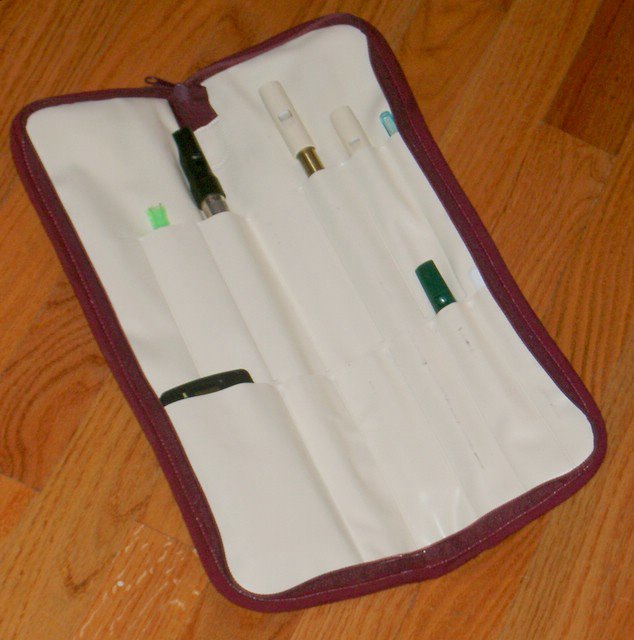
My wife, who knits, and loves me, suggested that a knitting needle case might work very well for storing whistles. I purchased one from Joann Fabrics. It has enough pockets to hold three or four metal whistles, but probably wouldn't fit wood or plastic whistles. The slots in the case are also too small for anything pitched lower than soprano D. It also holds my tuner, extra fipples, and accessories. The outside of the case is quilted fabric, and the inside is plastic. There is a zipper around the outside to close the case.

You can click on the pictures to enlarge them.

The case normally costs $14, but it's pretty easy to find coupon codes for Joann.com; just check back regularly enough and you'll find a code for 40-50% off on the home page.

This case suits me well since I play cheap whistles. If I played $200 whistles I'd probably want something nicer.

I've also been told that drum stick bags make good, cheap whistle cases. You can impress your seisiún with a coffin case for your whistle.

Update: The Whistle Shop is now selling a couple drum stick bags as whistle cases. They're a bit more appropriate, I think, than the "coffin" style mentioned above.

Tuesday, November 08, 2005

Personal: Sunflowers

A snapshot from a pumpkin-picking trip.

Tuesday, November 01, 2005

Practice: Dog Panting

At my last lesson my teacher asked me, "Do you [when not playing] think a lot about breathing?" I told him that yes, I do.

Ornamentation semantics

We talked for a while about the "breathing as ornamentation" idea expressed in that post. He both agreed and disagreed, the distinction being how you define "ornamentation." I could say that ornamentation means:

  1. Any conscious modification of a tune or deviation from the printed score.
  2. Any modification intended to call attention to itself in some way; a flourish or filigree.

My teacher feels that although you frequently drop notes while breathing that doesn't mean the gap has to be long or obvious. So it's an ornamentation in the sense that it's a change to the melody but not an ornamentation in the sense that it isn't really supposed to stand out. I can go along with that. But then again, I find that in general my favorite ornaments to listen to are the ones that don't really stand out.

Diaphragmatic breathing

As I learn to play tunes faster, I need to breathe faster, too. How can I learn that? My teacher wants me to focus on using my diaphragm.

Folks who have studied experiential anatomy (or maybe just classical flute) know that there are many different "methods" of breathing. You can breathe in by expaning your chest or contracting your diaphragm. The latter is advantageous for flute and whistle as you can move more air faster with your diaphragm than with your chest. Also, breathing this way won't move your shoulders, which interferes with how you hold your instrument.

We tried a couple of exercises to help me learn to focus on the diaphragm while breathing:

  • Put your hand on your diaphragm; it's just below your belly button. Breathe, and try to feel the muscle in action.
  • Pant like a dog, really quickly. You'll have to use your diaphragm, because it's the only way you can breathe that fast.
  • You can find more exercises on this page if the previous two are not enough.

I also found this old chiffboard post by David Migoya which concisely expresses something I've noticed while practicing the whistle:

Part of the key to good diaphram control is the use of the nose. Not only should you know how to take in breath through both the mouth and nose while you play, but you should know how to EXHALE through your nose WHILE you play. This gets rid of "stale" air and greatly increases the capacity of your body to take in fresh air for playing. I don't do this a lot on the flute, but I use it quite a bit on the whistle as I'm not using near as much breath.

I've found that if I'm not careful about regulating my breathing I can have too much air in my lungs and this makes articulation difficult. But I can breathe out through my nose while playing to get down to a more comfortable volume of air.