Showing posts with label photos. Show all posts

Sunday, April 06, 2008

Téada

I've decided that I had better post more photos from the 2007 Dublin Irish Festival before the 2008 Festival rolls around! So here are some photos of Téada.

It was raining cats and dogs when I pulled into the festival on Sunday afternoon. The police had shut the festival down because of the danger of lightning. They told me at the entrance that only "participants" (entertainers) were being allowed in. When I produced a participants' ticket, they told me that I still couldn't go in. Go figure.

Eventually, the gates were opened. When I got to the tent in which Téada would be performing, it was almost empty, although it filled up quickly as people came back into the festival. The band came in and started setting up their instruments and doing sound checks.

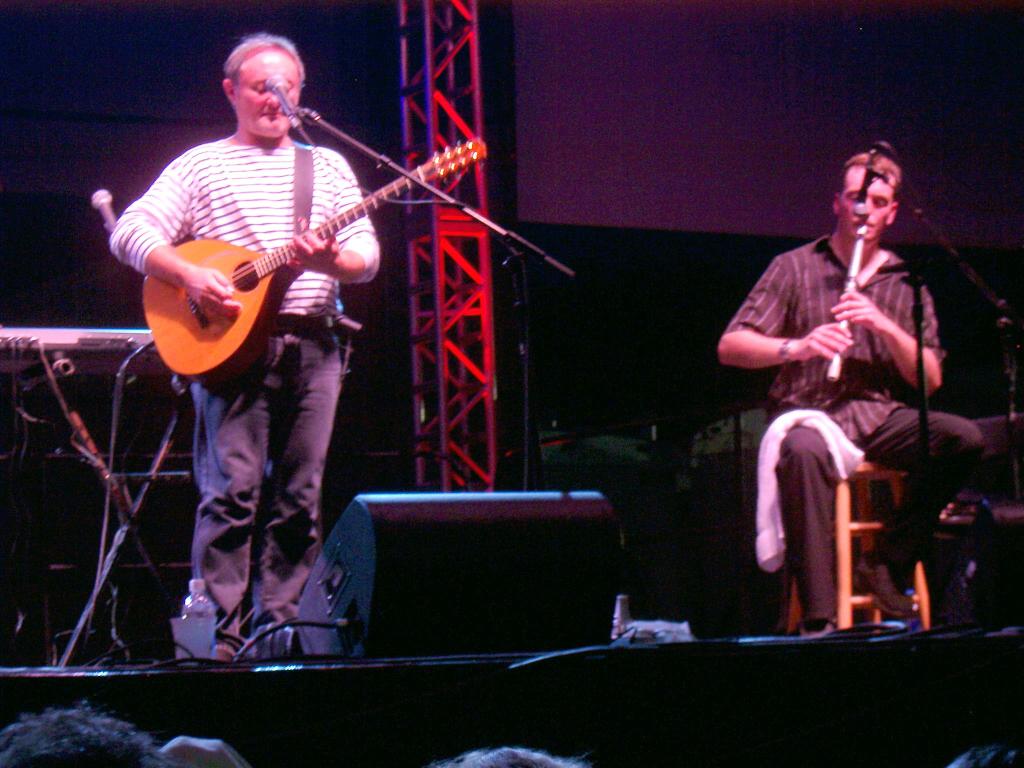
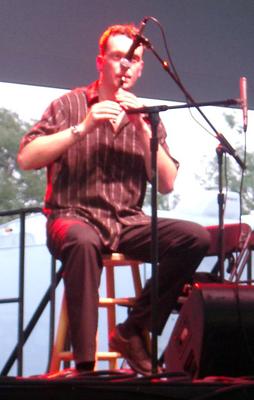
Here's a photo of flute player Damien Stenson during the sound check.


Yes, that is a B♭ flute on his lap. No, he didn't play it during the show. Before the show started, an audience member (not me!) walked up and asked to try his flute. He handed it over to her, seemingly without a second thought.

The band also includes bodhrán player Tristan Rosenstock:


...fiddler Oisín Mac Diarmada, Paul Finn, playing button box:


Seán Mc Elwain plays guitar and bouzouki.


Readers familiar with Téada's earlier incarnations will notice that this is a substantial change in lineup from the performers featured on Téada's first couple of albums. To my ear, their sound is different as well. No matter how you felt about their previous work, I think that their most recent album, Inné Amárach, deserves a listen with a fresh ear. There's a wide variety of tunes, mostly dance music, but not just jigs and reels. There are no songs; the album is strictly instrumental. It really is a "new band." The title is Irish for "Yesterday Tomorrow," and I think it perfectly captures the spirit of the album — an obvious knowledge and respect for the sources of traditional music inside of a contemporary sound. The US version of the album includes a promotional DVD about the band which is in much the same spirit. Besides featuring Téada, it also includes (short) interviews with Peter Horan, Sean Ryan, and Verona Ryan. The DVD is interesting, but unfortunately doesn't focus on performances of complete tunes. The CD, however, is first-rate playing from start to finish. I really like Inné Amárach.

Sunday, October 28, 2007

General Guinness Band

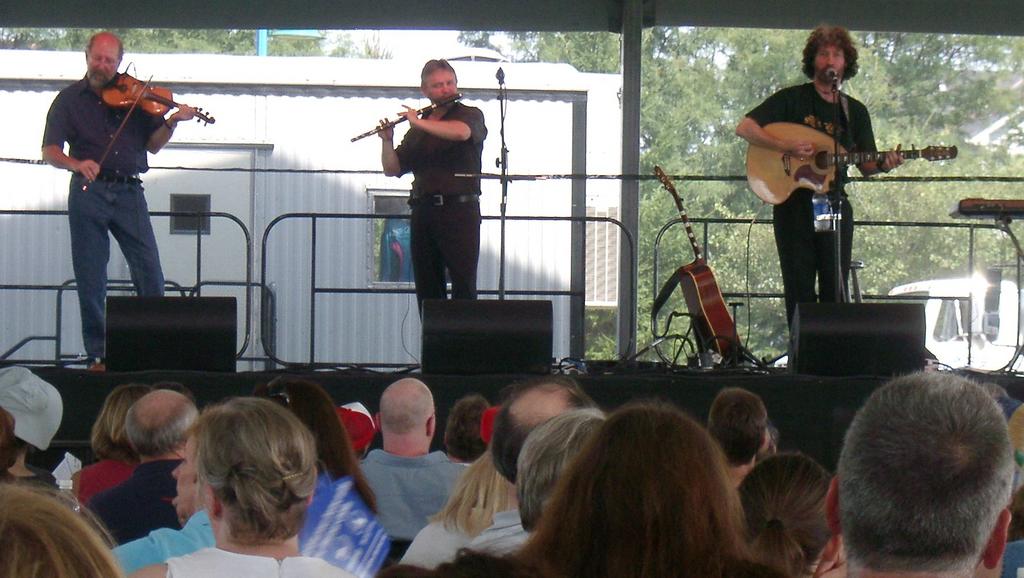
The photo above is the Columbus-based General Guinness Band playing at the 2007 Dublin Irish Festival. The members, from left to right, include guitarist Steve Steele, bodhrán player Tom Davis, vocalist James O'Shea, flute player Larry Dulin, plus fiddler Charlene Adzima, who is not, I believe, a regular member of the band, but who played with them during all of their Dublin Irish Festival shows.


Thursday, October 18, 2007

Niamh Parsons and Graham Dunne


Well, it's been entirely too long since I've posted any photos from the 2007 Dublin Irish Festival, and since I took a bunch of pictures at the CCÉ show last night I'd better work on clearing the backlog.

Niamh Parsons and Graham Dunne played a nighttime show in the pub on Saturday, mostly featuring songs from their latest album, The Old Simplicity.

For recent comments and photos from Niamh, check out Niamh's Musings, her blog.


Monday, August 13, 2007

Boys of the Lough

Here are some photos from the Boys of the Lough performance at the 2007 Dublin Irish Festival.

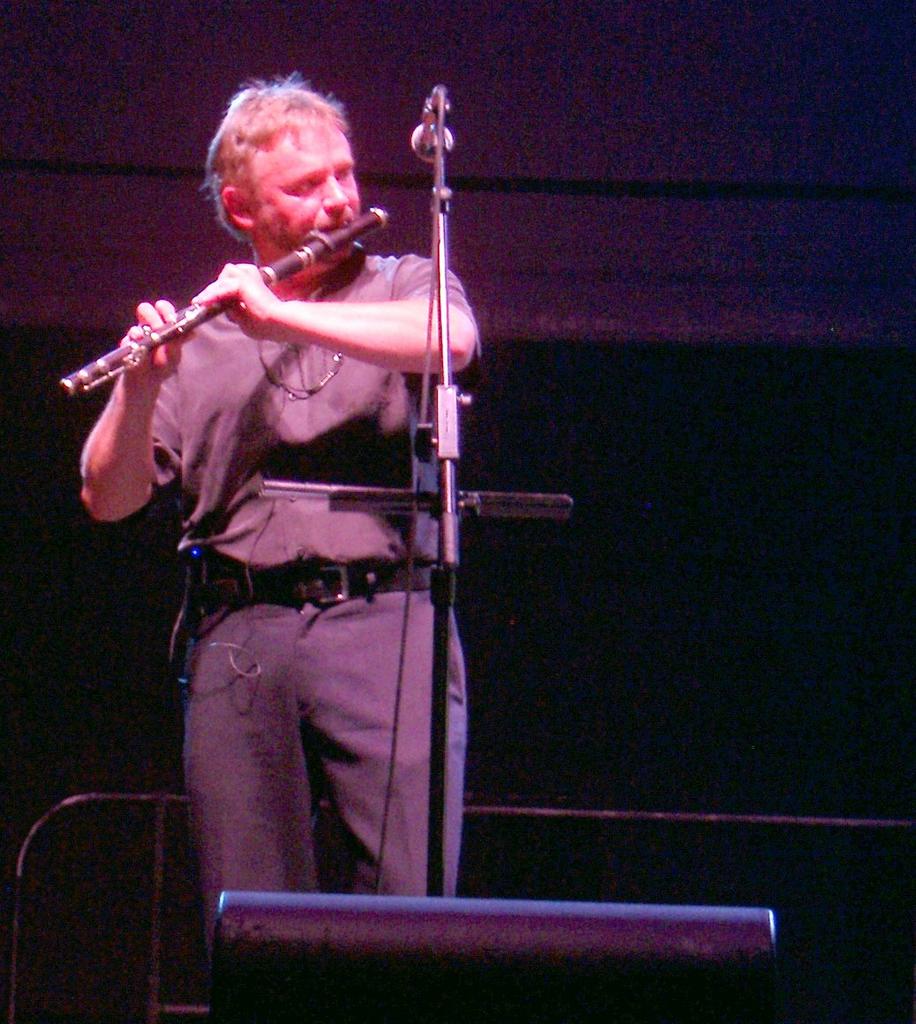
The photo above is from flute and whistle player Cathal McConnell's excellent, solo whistle rendition of Harvest Home. He played the tune three times, with increasingly complex variations. I recorded his performance of this tune and will post the recording if I can get his permission to do so. When he received a well-deserved cheer after he finished the tune, one of the other band members said, "You've just made an old man very happy!"

Fiddler Kevin Henderson is from Shetland, and brought an interesting musical color to the group. He played a solo set of Shetland fiddle tunes which were quite striking; a bit slower-paced and less driving than the dance tunes which comprised the majority of the group's performance.

Wednesday, May 02, 2007

Chris Norman

Nova Scotian flute player Chris Norman came to the Ohio State University this past April as part of the Johnstone Woodwind Master Series in conjunction with the Central Ohio Flute Association. He and guitar player Andy Thurston played a rather unusual show on the night of 21 April. The first half was an informal concert featuring mostly traditional Scottish tunes, with some Irish, Cape Breton, and original compositions as well. He was joined, at times, by Robert Aitken on piccolo and a local woman named Casey (I didn't catch her last name) on piano. Chris said that he had met Casey at a Kinko's the day before. The concert became even less formal in the second half of the show as he invited the conference attendees to get out their instruments and play along with some tunes. There were perhaps 50 or so Boehm system flute players, a couple guitarists, a pianist, one other simple-system flute player besides Chris and myself, and one bassoonist!

The photo above shows Chris playing the Scottish smallpipes. Although they're fingered like the GHBs, Chris said they originate in the music of the Scottish Travellers rather than the mainstream Scottish music tradition.

Here's Chris, Andy, Casey, and Robert playing a tune together.

The photo above is from the second half of the show. Chris projected the scores for the tunes, played them through a couple times, had everyone play along, and then gave some feedback to the audience, mostly on rhythm.

The show wasn't particularly well-publicized outside of OSU. I was lucky to hear about it, because it was a great concert.

Wednesday, April 04, 2007

The Kells

Some photos from a house concert featuring The Kells last month...

Thursday, August 10, 2006

Photo: Burke Forest

A forest of Burke whistles at the 2006 Dublin Irish Festival.

Monday, July 17, 2006

Recordings: Séamus Ennis in the Alan Lomax Collection

Here are two recordings and a photo of Séamus Ennis, courtesy of Alan Lomax and the Library of Congress.

Saturday, August 27, 2005

Shows: The Kells [DIF]

The Kells performing at the 2005 Dublin Irish Festival. That's Brian McCoy, who taught the festival whistle workshops on the right. I only got to see about half of their performance since it was getting close to the end of the day and my three-year-old daughter was ready to leave. The Kells play energetic, traditional music; you can hear it here.

Monday, August 22, 2005

Interviews: Colin Melville

Colin Melville has played Highland pipes, Scottish smallpipes, and whistles for the Tannahill Weavers for five years. I spoke to Colin after their Saturday evening show at the 2005 Dublin Irish Festival.

The tape of the interview is quite noisy, so any errors in transcription are of course mine.

Learning to Whistle: Do you think there's any such thing as a "Scottish whistling style" (as opposed to repertoire), or is whistling pretty much wistling?
Colin Melville: I think the actual method of playing is pretty much the same for everybody. I think when you talk about Irish style or Scottish style or whatever else it's more with the material you're playing, and playing style is probably more down to the individual than the country you're from, I guess.

LTW: It does seem to be fairly common that a lot of Scottish whistlers are also pipers. How does piping affect your whistling?
CM: Well, obviously you use your fingers, so that's similar, but you know the scale is completely different. Obviously, with the bagpipes you've only got nine notes to deal with (obviously have a lot more on the whistle) and you have to learn a lot of new decorations. That's probably the toughest part, for a piper to change their decorations. When you first pick [the whistle] up you try and do the same things, but you have to start using tonguing and stuff like that. It's a different discipline.

LTW: How do you rehearse a tune where you use pipes and whistle at the same time? ...There's such a difference in volume...
CM: When we practice with the band — well, most practices — I usually use the [Scottish] smallpipes, in place of the Highland pipes just for that reason, in spite of the fact that it makes for a color difference acoustically. Other people can hear what they're practicing as well!

LTW: I've read that when you play the whistle and the Highland pipes together you use an E♭ whistle, but it looked like Phil was playing an A whistle tonight?
CM: No, everything we use in the band is all — well, because of the pipes being in B♭ — is tuned around that. There are capos on the guitar and the bouzouki, and the fiddle is tuned up. All the whistles and flutes are E♭ or B♭. The one which looked like A, that'd be a B♭, and then you've got the high E♭ and the low E♭s.
LTW: Right, because [the Highland pipes, which play a tone closer to B♭ when an A is fingered] are not concert pitch....
CM: Yeah.

LTW: In terms of playing the whistle, who are your favorite artists to listen to for performance ideas?
CM: I'd have to say Brian Finnegan. He's a star. I can't get my head around some of the stuff he does with it sometimes. With Flook, his band; they're great. You know, there's so many up-and-coming guys that play, a lot of them pipers... they're getting into different instruments. Findlay Napier (of Back of the Moon), I heard him recently playing the flute... absolutely fantastic. Finlay MacDonald, a great piper, he's also really good on the whistle especially.

LTW: Let's say you like to listen to Scottish music and you want to learn to play it; is there a "short list" of "core tunes" you might want to start with...? I'm not saying you need to list the tunes, but where would you look to begin with?
CM: It's kind of funny, when you go around Scotland, to different parts of the country, if you go down to sessions or if you play with local musicians, you do find that small regions have a set, "core tunes," but when you go to different regions there are different "core tunes." There are obviously some that transcend, but everybody has a set of tunes that they can easily play together. But it's funny, when you go to a different side of the country it's a different set of tunes. And that's the way that you find them. Most people, to find them, go to sessions, play with other guys, and you hear them all the time. I wouldn't say there are specific books or recordings that have got just these tunes in them....
LTW: ...because I look at the Tannahill Weavers and there are a lot of tunes which interest me, but you guys have [14] CDs, and...
CM: Yeah, where do you start? Funny enough, a lot of tunes that the Tannahills recorded way, way back, they're now very popular tunes, whereas when they recorded them they were unheard of.

LTW: I was trying to learn Tranent Muir by ear from your recording and play it on the whistle and I kept needing to go into the third octave....
CM: Very often you just make something up which sounds OK. The songs do tend to go way out, further than a whistle can, definately further than the pipes can. So you very often find yourself trying to stick as much as you can to the melody line but when it goes way above or below you just have to make something up!

LTW: You do [onstage] some fairly impressive feats of instrument changes [e.g., going from the whistle to the smallpipes to the Highland pipes, which requires strapping and unstrapping the smallpipe bellows]....
CM: [Laughs.] Not for the first time I've been caught out a few times — everyone's staring at me, and I'm... "What's wrong?" I'm supposed to be playing the smallpipes or something and I'm just standing there.

LTW: I know you guys recorded a tune from a Scottish whistle tutor. But I haven't seen that book in the U.S. Have you ever seen a whistle tutorial with Scottish music that you liked?
CM: To be honest, I kind of learned through sessions, and bands playing along. When I started playing folk music I was a piper, and I thought, I've only got a few sets [for the pipes]; I'd be sitting there the rest of the night, and I thought, I'm going to have to do something here. So that's how I started playing the whistle. Kind of unconventional roots. I have come across a few tutorial books over the years and they're varied in quality. You know, everyone has at least something that teaches you something new, so it may just be best to go out and buy a few of them, if you can find a few kind of cheap ones, then you pick up lots of little bits and pieces....
LTW: Can you tell me about the whistles you play; who makes them and what do you like about them?
CM: The low whistle I play is a Chieftan. I've been playing a low D Chieftan for a long, long time, and when I joined the band I just naturally got an E♭, because I'm just so comfortable with it. I recently ordered a set of high whistles from a guy called Chris Abell, from North Carolina. So you get the same head with the E♭, the D, and C bodies, and I just think they're wonderful. I just got them a couple months ago, and you can really hear them coming in now; they're starting to get "played in." They're just a joy to play. I definately recommend them. We also use the cheap ones; the B♭ one we use is just the Generation. You have to go through a box of them; you have to find a "good one," to spend time going through them.

LTW: How do you orchestrate a tune, decide which instruments you're going to put to it? Is it trial and error or...?
CM: Trial and error to a certain extent. There's a format we use very often on stage. You know, you're not going to put the bagpipes in at the start and play the small whistle at the end because of the power of the bagpipes. You should put them at the end if you're going to put them in a song; you get that blast. As far as choosing my instruments, trying to decide whether to play the whistle with the smallpipes, or the high whistle with the smallpipes, that part usually depends on what Phil is doing, if he's playing the flute and whistle as well. Two whistles together sound lovely; you can throw lovely harmonies in. But if I'm playing smallpipes and he's playing whistle it gives you more freedoms; you can mess up and get away with it! With the same instrument you notice every little — if somebody does something slightly different you can hear it. When playing different instruments it gives you a little bit more of a free reign with what you're doing. So that's something to barter.

LTW: What's it like to join a band that has three decades of history behind it before you came on?
CM: Yeah, it's pretty weird. It's pretty weird. It's great, you know. I was just handed this opportunity... Do you want to join the Tannahill Weavers? "Hmmm... Let me think about that..." [Laughs] Well now I've put in five years and I'm quite comfortable with it. At the start it was quite, quite daunting.
LTW: Did you have to study all their old material, to pick up the tunes?
CM: Yeah, yeah. I knew the piper who was before me in the band; he was very helpful with it. It made things a lot easier because he spent a lot of time going through the material with me. In the first gig — actually, I just remembered that — the first gig I did with them was in Germany, and I only met Roy the afternoon of that gig; it was the first time I'd met him. [Ed. note: Roy lives in the Netherlands.] Up until then we'd just been practicing to tapes and things. That was pretty weird. I was pretty nervous about it, but it all went well I think. I'm still with them so I must be doing something OK.
LTW: It seems like you're doing quite a lot. You're not just piping; you're involved in the production and [writing] the music....
CM: Yeah; that's a really good opportunity for me because the band records — well, we usually do it on our own — so we do a lot of the recording and then there's a sound engineer who comes in and helps us with it. Because if you're in a commercial studio you're really pushed for time; it's all money, money, money. But because we have our own little place we can sit and take our time, follow our ideas and mess about with things.

LTW: Roy told me that you guys never perform The Great Ships live, and I'm curious: Are there songs that just can't be done live, or...?
CM: Yeah, there are some songs that are more difficult to come up with a live arrangement. Just for an example there are a lot of songs and tunes that John plays cello and viola — all sorts of "stringy things!" — and he can't do that live and some things that there'll be a kind of technical part in the arrangment and that becomes a lot more difficult. You have to come up with a new arrangement basically to do that live. We like to do things live pretty much the way they are on the CD.

LTW: Do you have any good stories from your tour?
CM: [Laughs] Uhhh.....
LTW: ...any you're willing to repeat?
CM: Yeah, exactly! Here's a funny one: Coming through customs, coming into the country, just last weekend. John the fiddler, he came up to the guy; you know, you get a little interview. The guy says, "What are you doing here?"
"I play in a band."
[The customs inspector asked] what kind of band, what kind of music do you play, what instrument, and all that, and they're chattin' away, and [the inspector] is writing on this form, and he looked at John, and said, "So, your occupation would be...?"
John said, "Musician."
[The inspector] went to write it and he looked up at John and said, "Umm... I'll just write fiddle player; it's easier to spell."
It's true! Incredible, but true.
That will get me in trouble; I'll get pulled aside on my way out of the country!

Shows: Tannahill Weavers [DIF]

I've been a fan of the Tannahill Weavers since first hearing their "Lucy Cassidy" set on a RykoDisc sampler back in the late '80s, but I've been listening to their recordings with a bit of a new ear since taking up the tin whistle. But I'd never had the opportunity to see them perform live.

So I was delighted when I learned that they would be coming to the Dublin Irish Festival. I also requested an interview with the band, and Colin Melville soon agreed to spend some time discussing whistling in Scottish music; I've posted the interview separately. The band played three sets at the festival; I caught them on Saturday and Sunday.

The musicians in the Tannahill Weavers have changed over the band's 37 year history, but Roy Gullane (guitar, vocals) and Phil Smillie (simple system flute, whistle, bodhrán, vocals). Colin Melville (Highland bagpipes, Scottish smallpipes, whistles) is the most recent addition; he's been in the band for five years. Leslie Wilson (bouzouki, keyboards, vocals) and John Martin (fiddle, vocals) have both been in the band for over 15 years.

I was wondering what a band with 14 full albums (not counting compilations) to its credit would play in concert, and it turns out that their taste is pretty similar to mine, as they played most of my favorite tracks! They played music from across the history of the band, including several spectacular sets of dance tunes like The Geese in the Bog / The Jig of Slurs and the Arnish Light set. I really like their new version of Cam' Ye By Athol; they first recorded it on Are Ye Sleeping Maggie, but rearranged it on Arnish Light to include a Highland bagpipes bridge. They played two songs by Adam Skirving about the Battle of Prestonpans: Tranent Muir and Johnny Cope. Of the battle itself, Roy quipped, "...the most famous battle in Scottish history, because we won it."

Roy's inter-song chats were very much in the spirit of the Tannahill Weavers's frequently amusing liner notes (all of which you can read online). Here's one of the stories he told:

Two men were out fishing in the middle of a lake when a bottle floated up to the boat. One of the men leaned over and opened it and a genie floated out of the bottle. "I'll grant you one wish," said the genie.
"Don't I get three?" asked the man.
"No, only one," replied the genie.
"OK," said the man. "I'd like you to turn entire lake into whisky." There was a poof, his wish was granted, and the genie disappeared.
"You idiot!" screamed his companion. Now we're going to have to wee in the boat!"

The Tannahill Weavers were the first successful Scottish folk band to use the Highland bagpipes in a band setting, and their unusual tuning poses certain difficulties for whistle players. When Colin is playing the pipes the rest of the band has to adapt to this, especially when playing a diatonic instrument such as the whistle. Phil plays an E♭ flute with keys, and a B♭ whistle. When Colin is playing the whistle he is of course not piping and plays high and low E♭ whistles.

At one point I was watching Phil whistle when I saw him repeatedly lift his right hand and start tapping it on top of his left hand as he played. I couldn't tell what he was doing, but I overheard another whistler ask him about this after the show and leaned in to hear the answer. "It's just a trick," he said. He plays a very fast fingered vibrato by running the first three fingers of his right hand, with a little space in between them, across the second or third finger of his left hand, which has the effect of quickly drumming the left-hand finger against the whistle hole.

It wasn't the only unusual technique observed that evening, either; at one point Roy played his guitar with a violin bow. It was also interesting when Roy stopped playing his guitar or when Les played the keyboards. This allowed me to hear the guitar and bouzouki in isolation, which normally intermingle. The Tannahill Weavers are so tight as a band and their performances are so well-arranged that it's interesting for me to try and pick them apart and identify the individual elements which make up the overall sound.

The Tannahill Weavers played for just over an hour and a half on Saturday night. The set list was substantially similar to Saturday's but reduced as the band had a shorter time slot. Sunday afternoon I brought my three-year-old daughter, also a fan of the band, to see their third show. We were a little disappointed that they didn't perform "The Great Ships" — which my daughter has memorized and likes to sing along to — but Roy told me after Saturday's show that it's one of the songs they don't ever play live. [Colin later told me why.] Nevertheless my daughter really enjoyed the show; in spite of the volume and having a three-year-old's attention span she wanted to stay for the entire show.

Friday, August 12, 2005

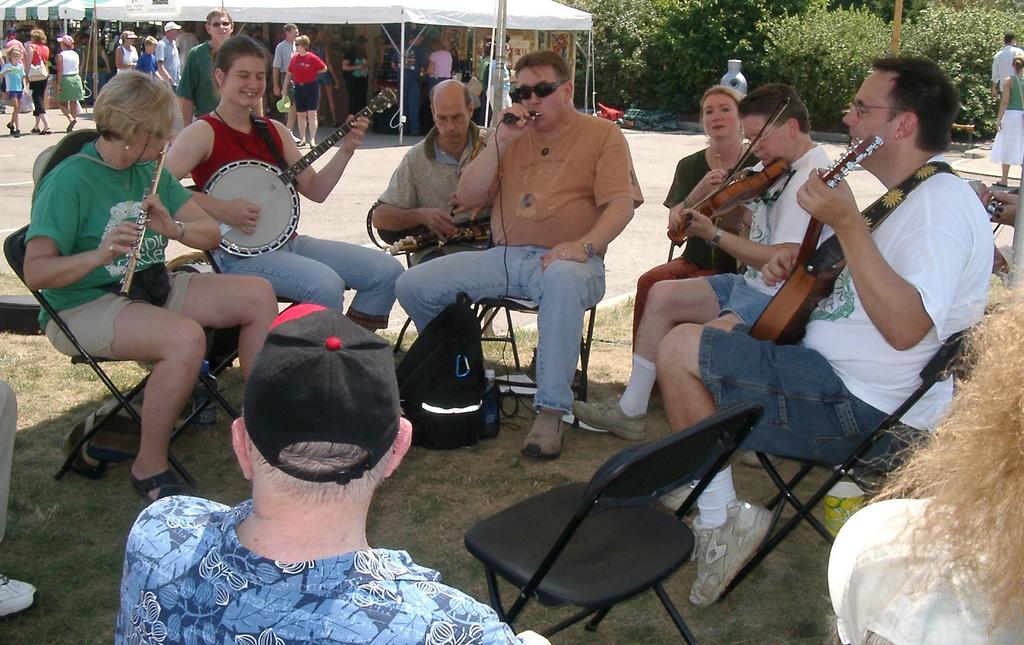
Seisiún: Sessions at the 2005 Dublin Irish Festival

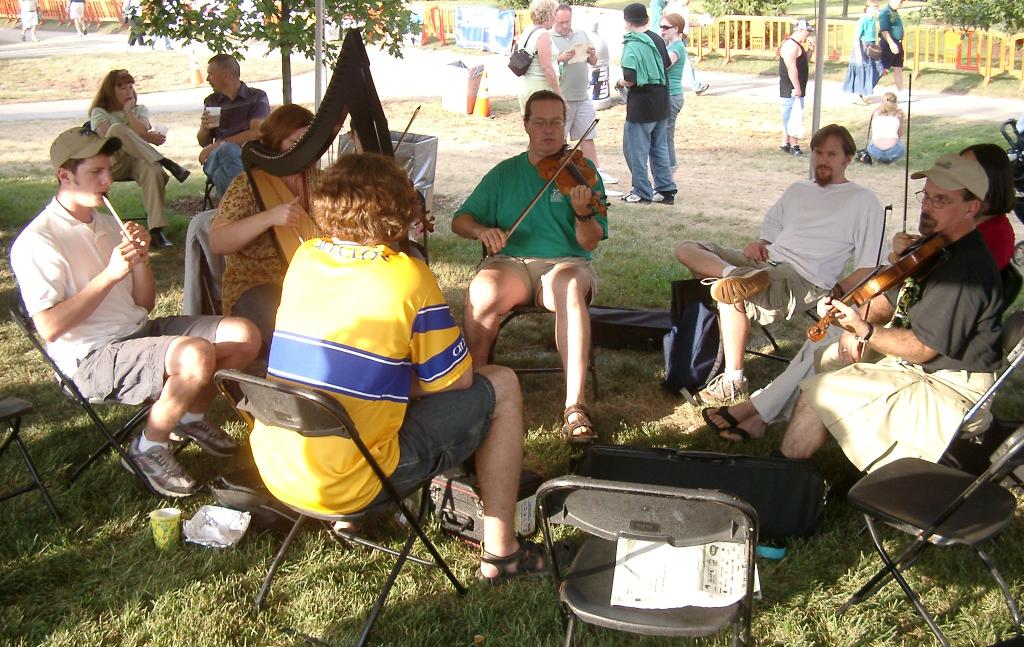
The photo above is my daughter dancing in the session tent. She loves Celtic music. She walked into the middle of the session and was leaning in close to the musicians to get a good look. Stuart, the fiddler with the green shirt, said to her, "You know, this is dance music. You could dance..." She did, and for the rest of the festival she was asking me, "Let's find more dance music!"

For the most part my whistling skills were too weak to keep up with the session. But I made a point of sitting down and playing when the session tent was empty or when there were only one or two people there, to keep things going.

Bardic Circle session playing at the Emerald Isle stage. I sat in for one tune, but I had my daughter with me on Sunday and it was kind of difficult to play with her crawling all over me!

The session tent again.

Thursday, August 11, 2005

Shows: Dulahan [DIF]

Dayton, OH-based Dulahan, with Leo Butler playing the tin whistle, performs at the 2005 Dublin Irish Festival.

By the way, you can click on the pictures on all of my recent posts to enlarge them.

Wednesday, August 10, 2005

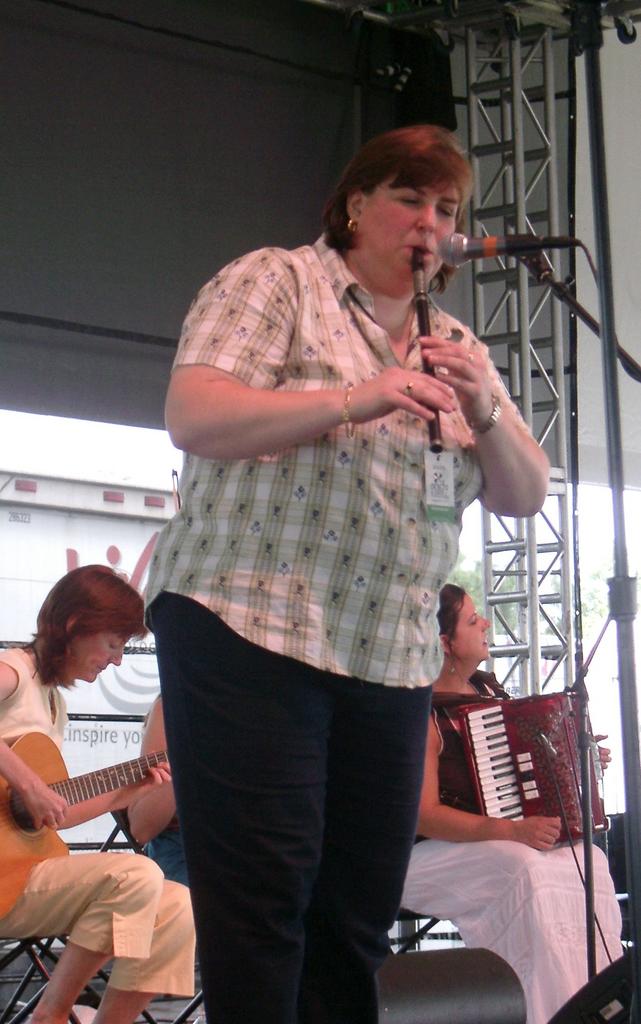
Shows: Cherish the Ladies [DIF]

I saw Cherish the Ladies on Saturday afternoon at the 2005 Dublin Irish Festival. Chiff and Fipple forums favorite Joanie Madden was excellent as always. She stomped to the beat so hard while she played I feared for the structural integrity of the stage!

But as good as Joanie is, it was hard to pay attention to her playing when the bodhran player started singing. Her name is Heidi Talbot and wow does she have a gorgeous voice! I hadn't heard her before as I've only heard CTL's older recordings, but I guess I'm going to have to get up-to-date.... Heidi also seems to have a solo record I might need to check out.

Update: CTL's new album Woman of the House, released a couple months after this show, is in my opinion their best record to date.

One of the things I've always liked about CTL is that step dancing has been a part of their sound — even on audio-only releases — from the beginning, and although I wasn't in a position to get a good photo, it was true of this show as well.

Monday, August 08, 2005

Shows: Oisre [DIF]

Oisre is a new band which includes Charlene Adzima of the Columbus-based band Aisling (Aisling also played the festival, but I couldn't make their sets). Oisre played on Saturday for at least two hours!

Sunday, August 07, 2005

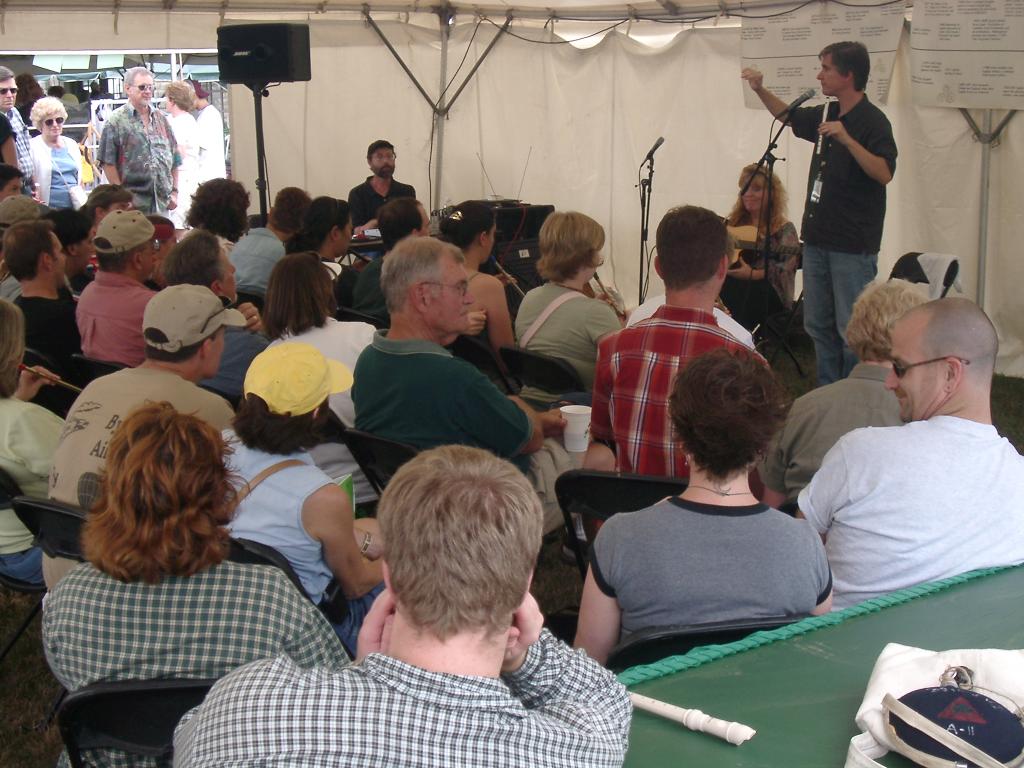
Shows: Whistle Workshop [DIF]

This is the first of a series of posts about the 2005 Dublin Irish Festival. They were expecting 85,000 people, and judging by the crowds and great weather I think there were at least that many.

You can look forward to lots of photos and comments on shows by Cherish the Ladies, Eileen Ivers, and the Tannahill Weavers (plus an interview on the subject of whistling in Scottish music), but it will take me a while to write all of that. So I'll start out with the first thing I saw when I entered the festival, which was my whistle teacher giving an introductory level ("introductory" in the "which end do I blow into" sense of the word) seminar on playing the whistle to a standing room only crowd of over 100 people. Brian did a great job keeping the crowd engaged and laughing.

Monday, May 16, 2005

Another New Whistler


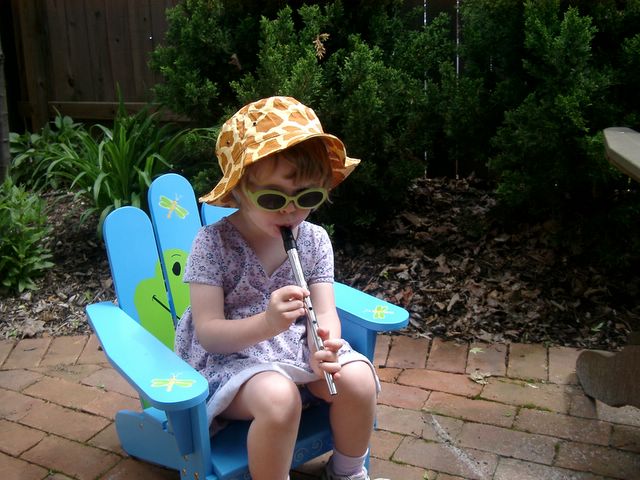
This is my three-year-old daughter playing a Clarke Sweetone. Her favorite tunes thus far are Cockles and Mussels and the Bob the Builder theme song. Transcriptions for the latter available upon request.

Update: Here are some more pictures of young folks "whistling."