Thursday, June 29, 2006

Technique: Speed Limit

A good quote from a friend of Brad Hurley, related by Brad on the Chiff and Fipple flute forum:

...playing good tunes too fast is "like roller-skating through the Louvre."

Isn't that the truth? I love Altan, but sometimes they play stuff incredibly fast. For example, I much prefer Matt Molloy's version of Drowsy Maggie to Altan's, mostly because of the more relaxed pace in Malloy's recording. (They play somewhat different versions of the tune, but it's really the pacing which makes the biggest difference to me.)

Some tunes sound really good played quickly, though. I really like Altan's "Tommy Peoples" set on Local Ground. "Harvest Home" and "John Ryan's Polka" also sound good when played really fast, I think.

Monday, June 12, 2006

WWW: Low Whistle and Sofa

File this under "non-traditional." (Link goes to embedded video.)

Friday, June 09, 2006

WWW: What is Irish Traditional Music?

This seems like a decent answer.

It is impossible to give a simple definition of the term. Different people use it to mean different things; the music shares characteristics with other popular and with classical music; and, as traditional culture changes, traditional music changes also, showing varying features at varying times.

Irish traditional music does however have some generally agreed characteristics which help define it...

Friday, May 26, 2006

Practice: Listening Speed

People tend to discuss the speed at which they play dance music quite a bit, but lately I've been thinking about the speed at which I can listen.

Before I started learning to play the whistle a lot of dance music sounded like a blur to me. It was too fast for my mind to follow. Learning about different rhythm types helped a lot since I could follow the structure of the tune. So did counting reels in cut time.

But more than anything it seems to be a matter of practice. I'm learning to "listen quickly." The more active listening I do, the better I can follow fast tunes, and the more satisfying the listening becomes for me.

Monday, May 22, 2006

Practice: Stuck in Your Head

When I started learning to play the whistle I chose tunes based on what other people I knew were playing and which tunes I liked at the moment. But lately I've been using a different strategy, with great results.

Ever hear of an earworm? It's just a word for songs which get "stuck in your head." Not surprisingly, this started happening with tunes as I started listening to more and more Irish and Scottish music. One day, unable to get "Harvest Home" out of my head, I decided to put my affliction to good use and learned the tune. I found I was able to memorize it in about half an hour or so, instead of the large number of days it had taken me to memorize tunes the past.

Since then, I've seen "earworms" as opportunities. Whether or not a tune is on the list of tunes I think I want to learn soon, when it gets stuck in my head I work on learning the tune. I find that having the tune cycling in my head means that I'm less likely to have my own mistakes confuse me as to how the tune actually goes. This is part 1 of the basic two-step process for learning a tune.

Wednesday, May 10, 2006

Shows: 2006 Dublin Irish Festival Entertainment Announced

The Dublin Irish festival is, I think, the best ITM entertainment value in the midwest U.S. It's simply amazing how many great bands you get to see for eight bucks a day, when you'd have to pay several times that amount to see any of these groups individually. I also got to interview Colin Melville of the Tannahill Weavers. Here's my roundup of posts on last year's festival, for those who couldn't make it.

The festival just announced this year's entertainment lineup. See you there!

Saturday, May 06, 2006

Whistles: Larry's Low Whistle

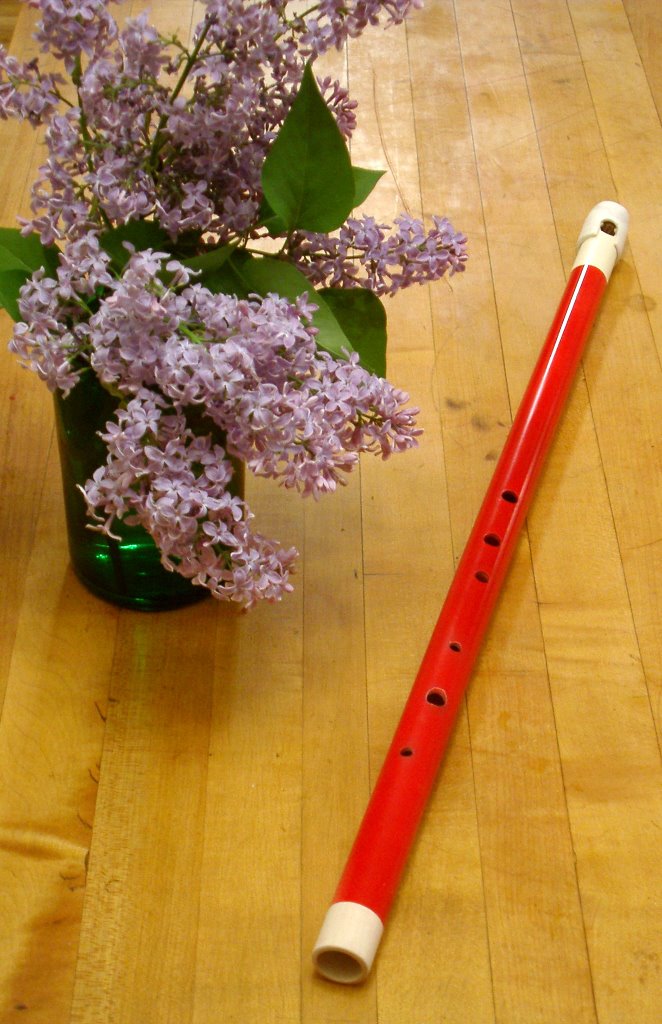
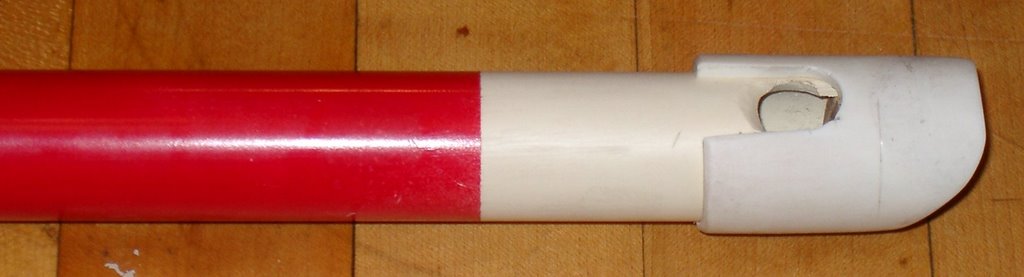
I mentioned earlier that Bardic Circle is a beginner-friendly session. Here's a shining example: Larry Shicks, one of the guys from that session, showed up one day and told me he'd made me a whistle. So I bought him a pint, which seemed like a good way to say thank you. That's it on the right, and there's a close-up of the fipple at the end of this post. Click on the pictures to enlarge them.

The whistle is a low D made of PVC, with a wooden fipple. Note the offset finger holes and decorative paint. It's pretty quiet, requires a good bit of air, and has very little back pressure. The sound is reminiscent of a pipe organ or pan pipe.

I'm having a somewhat tough time getting a great tone out of it consistently. This is my first low whistle, so it could be just my own inexperience. The air requirements and back pressure are very different from my soprano whistles. Reaching the holes is no problem; standard grip works better for me than piper's grip, though. The only thing I have a hard time doing is keeping my bottom hand pinkie on the whistle.

Thursday, April 27, 2006

Practice: Methods of Memorization

One of the things I like about learning to play the tin whistle and Irish and Scottish music is that my constant need to memorize new tunes (and songs, as I like to sing) is giving me a real mental workout. My day job also requires me to remember large amounts of information, but memorizing tunes seems to work a different part of the brain. Research indicates that "mental exercise" can reverse the decline in brain function in old age, so the more the better!

I notice, though, that the method I use to learn a tune has changed since I took up the instrument last year. Previously I would play the tune through until I no longer required notation (I wasn't doing much ear learning at the time). Now, however, I find it much more effective to learn a measure or a phrase and then build on that, one piece at a time. This seems more effective both when learning from score or by ear for me.

I spoke to a fiddler who uses a third method. He learns the first note of each measure or phrase — the "outline" of the tune — and then fills in the rest.

I don't know if any one of these methods is "best," but it's interesting that there are different ways to do the same thing.

Tuesday, April 25, 2006

Seisiún: Slow Session

I went to a new (for me) session yesterday. It's a slow session, and very different from Bardic Circle, the other session I attend.

Bardic Circle started life as a beginner's session and is still very beginner-friendly, but many if not most of the regulars have now been playing together for several years, have a pretty wide repertoire, and the tunes are not generally played slowly. I spend most of my time at Bardic Circle sessions listening instead of playing, which doesn't bother me at all.

At this session, however, everyone is studying the same 20 or so tunes, and I happened to know six or seven of them. The group played, in general, much slower than Bardic Circle. We also did some ear learning exercises, so I ended up playing more than I listened. I'm going to work on learning some of the other tunes that group plays.

Overall it was a nice experience.

Monday, April 10, 2006

Technique: Bottom Hand Pinkie

I've been experimenting with putting my right (bottom) hand pinkie finger on the bottom of the whistle, below the bottom hole. My teacher had recommended that I do this ages ago, but it never felt natural, and putting my third finger down on the bottom hole when I play a C♯ (or sometimes B, etc.) always seemed to work well enough.

Until The Atholl Highlanders. Playing A-c♯-e repeatedly is just a lot easier when I don't have to have my bottom-hand third finger moving. And similarly for some other parts of that tune.

Update: I received a suggestion in private email to try a different technique with The Atholl Highlanders, which helps even more. But I still find the pinkie helpful in this and other tunes.

It still doesn't feel quite natural, but it's a lot easier to play some phrases, and I think I can keep the whistle steadier this way.

This is (temporarily, I hope) somewhat confusing at the moment. I'm having to relearn certain passages to make optimial use of the new grip and I'm tending to grab too hard with my right (bottom) thumb and pinkie right now. But when I do it right I'm finding that some passages just come out a lot cleaner, like the second to last measure of both parts of Harvest Home.