Thursday, February 16, 2006

Technique: Wandering Fingers

I've been working on cleaning up the transitions between notes, especially when lots of fingers are involved, e.g., low B to high D. One thing I've noticed which really hurts this transition is allowing the fingers on my left and right hands to "float" at different distances from the whistle when I play the B. In other words, if my left hand middle and ring fingers are a half inch from the tone holes and my right hand fingers are all two inches from the tone holes when I'm playing a low B, the transition to high D will not be clean.

In general, I find that if I allow my fingers to stray too far from the tone hole when they're not actually in contact with the whistle (e.g., the fingers on my right hand when I'm playing a G) then it really hurts my performance.

I normally don't look at my fingers when I'm playing, but if my performance gets sloppy I find it somewhat valuable to take a look and make sure that my fingers are within an inch or so of the whistle when they're not in contact with the tone holes.

Friday, January 27, 2006

History: Etymology of Pennywhistle and Tin Whistle

I've been doing some research on the origin and use of the words "pennywhistle" and "tin whistle." It seems that usage was uncommon until the 20th century. Robert Clarke began selling his instruments around 1843, but his company was advertising them as "Clarke London Flageolets" or "Clarke Flageolets" in 1900. I checked some early 20th century reference books, and neither the dictionary nor the thesaurus nor the 1911 Encyclopedia Britannica mention either term, although the latter's whistle entry does mention metal flageolets.

Although usage seems to be uncommon, however, both terms do predate Robert Clarke. With the aid of my friendly local librarians I found citations in the Oxford English Dictionary. Note that, unlike most dictionaries, OED inclusion and citations are chronological rather than by popularity so an OED citation does not mean that a word was in common use.

At any rate, the OED's citation for "tin whistle" comes from John Neal's 1825 novel Brother Jonathan:

As if he were sounding a charge with... a tin-whistle.

The OED has multiple citations for "penny whistle:"

1730 Gabriel Odingsells Bay's Opera III. 64 "Musicians with Halters about their Necks—Their Instruments strung behind, penny Whistles, Trumpets, and so forth, in their Hands"
1817 Scott Rob Roy I. x. 233 "Pipes!—They look more like penny-whistles."
1931 N. Douglas London Street Games (ed. 2) 29 "I went down the lane to buy a penny whistle, A copper came by and pinch my penny whistle."

It would seem that the speculation that the words "tin whistle" and "pennywhistle" date back to the first mass production, namely, Clarke's instruments, is probably incorrect:

  • The words were in use earlier.
  • Clarke and Clarke's company called their products "flageolets" for at least part of their history.
  • The words didn't become popular enough to be reflected in dictionaries or encyclopedias until the last half of the 20th century.

Tuesday, January 24, 2006

Technique: Grey Larsen on Breathing

I found a Grey Larsen article online, Advice for Flute and Whistle Players on Finding Good Places to Breathe in Irish Dance Tunes [PDF], which covers some of the same material I discussed in my comments on breathing as ornamentation in more detail:

Players of instruments other than flute and whistle may want to bear in mind that although they can, and often do, play in a non-stop manner, their music may benefit from the introduction of occasional spaces. Creating such spaces can clarify your phrasing, much as a sentence becomes more clear with the appropriate use of punctuation marks such as commas, semicolons and the like. So, it is important and useful for fiddlers, accordion players, pipers, banjo players, etc., not just flute and whistle players, to develop a sense of when and where to eloquently leave out notes.

The whole article is worthwhile.

Monday, January 23, 2006

Tweaks: Methods of Muffling a Whistle

The Contenders

The Hoover Whitecaps

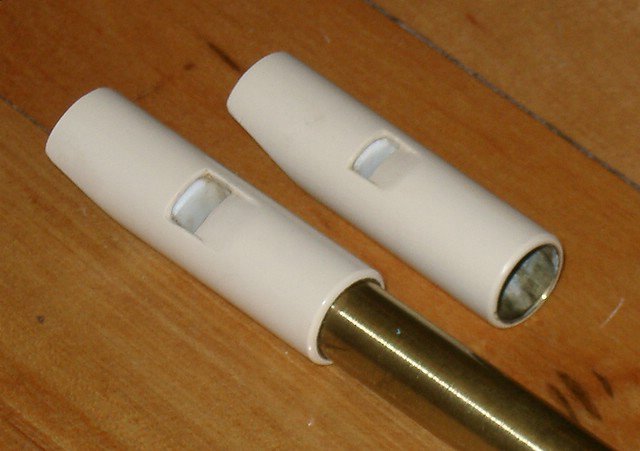
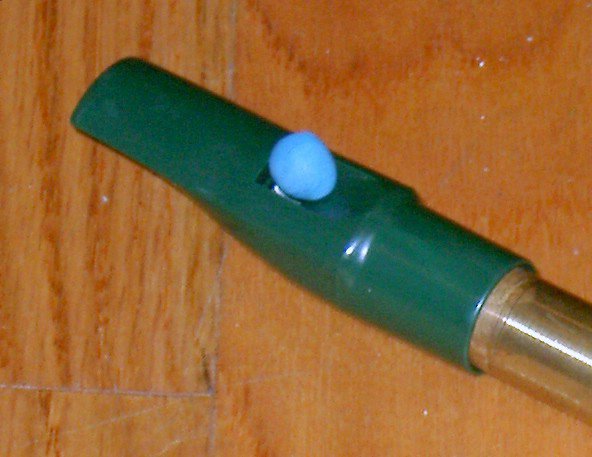
The Hoover Whitecap is a line of replacement fipples handmade by Mack Hoover, which sell for about $25 each. They're available in "quiet" and "regular" varieties. Pictured at right are both variations. The "regular" model, mounted on the whistle in the photo, has a somewhat larger window than the "quiet" model.

The Blu-Tac™ Tweak
For this tweak, make a small ball of "Blue-Tac"/poster putty and put it in the window of the whistle. The further you put it towards your mouth, the more it quiets the whistle, and the airier the sound.

The Tape Tweak
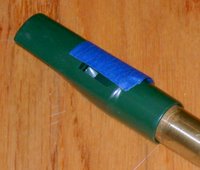
For this tweak cover part of the window with tape as illustrated. I usually use clear tape, but it didn't show in the photos very well so I've used blue painting tape in the photo at right for illustrative purposes. The more you cover the window, the more it quiets the whistle, and the airier the sound.

The "Joanie Madden" technique

Joanie described a technique on the Chiff and Fipple message board where you place the mouthpiece against your chin, below your mouth, and blow down into the fipple window (almost as if it were a flute). This is very quiet indeed, but I'm not including it in this comparison as it's a different animal altogether; try it and you'll see why.

The Results

(All measurements in dbSPL, A weighted.)

WhistleLow DLow GHigh DHigh GHigh BComments
Un-tweaked Feadóg Mark III7481939394
Un-tweaked Clarke Sweetone7078909093
"Standard" Hoover Whitecap7078809090Best-sounding fipple.
Feadóg with Tape Muffler6876868687Very airy sound. Fiddly.
"Quiet" Hoover Whitecap6169828488Sounds better than un-tweaked whistle. Very low air requirements; harder to play low D and E.
Feadóg with "poster putty" tweak6668798184Airy, mellower than un-tweaked whistle.

Conclusion

Although the Blu-Tac tweak produces the quietest results, it comes with a considerable cost in terms of tone quality. The "quiet" Hoover Whitecap produces the best tone quality of anything other than a non-quiet Hoover, but has different playing characteristics (much lower air requirements, especially on the low notes) than the other tweaks. Finally, none of the tweaks cuts the volume by a huge amount; 84 dBSPL, while quieter than the un-tweaked whistle, is considerably louder than normal conversation.

Wednesday, January 11, 2006

WWW: Raffle for the Porcupine Clinic

Whistlesmith Daniel Bingamon is hosting a raffle for the Porcupine Health Clinic, the only independent Indian community-controlled health clinic in the US, on his site. Your donations to a good cause can win you a good whistle!

Tuesday, January 10, 2006

Wednesday, December 21, 2005

Tunes: Learning to Polka

A few weeks back my teacher said I should learn a new tune, but that I should pick something other than a jig since my current repertoire leans heavily towards jigs. After considering a number of reels, I chose John Ryan's Polka, mostly because I didn't really get polkas.

I have a hard time recognizing polkas, much less playing them right. The 2/4 time signature sounds a lot like the 2/2 of a reel, especially if they're not articulated carefully. But my teacher pointed out an important difference between the reel and the Irish polka. The polka, he said, is the only type of tune in Irish music which has a backbeat, although I'm pretty sure he meant an emphasis on the half-beats rather than the second (last) beat in each measure. He told me that he played polkas "incorrectly" for ten years before someone told him about this.

Armed with this information I was able to go back and listen to track 5 of Mary Bergin's Feadóga Stáin 2 a bit more carefully and I can get a sense of what he means.
But it will be a good while before I can play polkas like she can.

Have a suggestion for a great polka recording? Leave a comment!

Tuesday, December 13, 2005

WWW: Remembering a Kwela Master

Kwela is a genre of music created in South Africa in the 1950s, and characterized by an upbeat, jazzy pennywhistle lead. The name is a Zulu word for "get up," and the police vans which patrolled South African townships during the Apartheid era were slangily known as "kwela kwela vans." It seems that folks who ran illegal gambling games on the streets of the townships sometimes used kwela bands as cover or as lookouts:

Dice rattle, streetwise young voices call bets and argue, the dice stop rolling, cheers and groans as the coins are scooped up again.

Feet come running and an urgent voice calls: "E Bops, kom maak gou -- hier kom die kwela kwela van!" ("Hurry up, here comes the police van"). "Tom Hark" has been watching for police at the corner.

Dice and cash vanish, out come pennywhistles and guitars, and the gambling school becomes a kwela band (the music named after the police van) and they swing into the irresistible tune of Tom Hark. The police rumble past in their van.

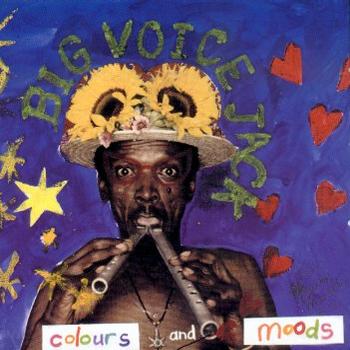
Aaron "Big Voice Jack" Lerole was "discovered" by a record company scout playing his pennywhistle in the street with his brother. They recorded a record the same day which eventually sold around five million copies. Six months later he was sold into slavery by the South African police. He was beaten by the farmer who had purchased him, which permanently lowered his voice, resulting in his nickname in later life. He escaped slavery after the intervention of an activist lawyer, resumed music performance, went on to tour Europe and Africa.

The kwela scene in South Africa essentially died when Spokes Mashiyane, one of its chief exponents, took up the saxophone. The kwela sound fused with Marabi, another indigenous South African music, forming mbaqanga. But Big Voice Jack continued to play Kwela, and made a comeback of sorts in the 1990s when South African-born Dave Matthews heard him play at the Bassline Jazz club:

However, it was at The Bassline Jazz Club in Melville Johannesburg that Jack's finest moment was set in motion. Jack was playing at the club and Dave Mathews, guitarist, songwriter and singer with the internationally acclaimed Dave Mathews Band, was in the audience. Dave's saxophonist had asked him to pick up a few pennywhistles while he was visiting South Africa and Dave approached Big Voice Jack after the gig to ask him where he could find them. Big Voice Jack decided to rather give his own whistles to Mathews. "I thought that I would never play in a big stadium in America, so I wanted my whistles to be there," says Jack. "So I gave them to him."

Big Voice Jack's generosity was repaid when the Dave Mathews Band invited him to come over to the States and play two gigs with them at the Foxboro stadium in Boston and the Giants stadium in New York. This invitation from arguably the hottest rock act in America at the moment is a fitting tribute to the lasting contribution that Big Voice Jack has made to South African music, and went down a treat. Jack's gigs with the Dave Mathews Band were recorded in a documentary by South African filmmaker Johnathan Dorfman called "Back to Alexandra." The film shows Jack on stage before an 88,000 strong crowd, jiving and jamming with the band like a man half his age. He went down so well that the band even asked him to play one of his own tunes, "Back to Alexandra," a song in which Jack gives vent to his lifelong hatred for guns.

Big Voice Jack died of throat cancer in 2003. You can buy his CDs through South Africa's One World or Amazon or Stern's Music. The latter has M3U audio samples!

Thanks especially to Keith Addison for publishing much of the linked material.

Update: Here's an MP3 of Tom Hark.

Saturday, December 10, 2005

WWW: Free Irish Music Download Blog

This site has been around for some time, but it's new to me. It links MP3s posted by various bands — mostly smaller groups — and includes a short blurb about each band and information on where to buy their CDs if you like what you hear. All linked downloads are legal.

For some reason they don't link their Atom feed, but it's here if you'd like to subscribe.

Wednesday, December 07, 2005

Recordings: The Chieftains / Live from Dublin

This will be a somewhat unusual record review.

First things first: I like The Chieftains. They're a great band and seem to be fine people. "Live from Dublin" is a tribute to Derek Bell, their long-time harpist and all-around interesting guy. But I'm not going to buy it, because their record label, Sony, chose to include software which is not beneficial to people who legally own the CD, behaves like spyware and is dangerous to your computer.

According to Sony and the Electronic Frontier Foundation, the software contains a defect which could allow malicious software to gain control over your computer. A similar piece of malware delivered on other Sony CDs in the name of copy protection was in fact exploited by virus writers.

According to Edward Felton, the software:

  1. Installs without meaningful consent or notification, even if you decline the license agreement
  2. Includes either no uninstaller or an uninstaller that fails to remove major components of the software
  3. Transmits information about you to SunnComm, the developer of the software, without notification or consent

If you already own this CD, don't put it in your computer. It is safe to put it in an audio-only CD player, however. If you have already put the CD into your computer then you may want to remove the Sony/SunnComm software from your computer. Don't use the so-called "uninstaller" included with the CD; like the uninstaller for Sony's other "content protection" system, it's as dangerous as software itself. However, the uninstaller linked on the EFF page has (at least temporarily) disappeared from SunnComm's site, and when you search SunnComm's site for an uninstaller, they try to talk you into updating the software instead. Unfortunately, there is little reason to believe that the problems disclosed thus far are the only problems with the software. [Update: Well, that didn't take long. A new problem in the patched version was announced while I was typing the original version of this post!] When a record label appears to presume that their customers are criminals, why would they worry about their customer's security? Why would I want to run software on my computer which does nothing for me? The EFF is suing Sony over this.

Think this doesn't apply to you if you have a Mac? I wouldn't count on it.

Sony would like to sell me a laptop. But given that they try to install this software and other software which is even worse on computers which they don't produce, why would I trust them not to put such malware on a computer they produce themselves?

I have no reason to believe The Chieftains have anything to do with this software being on their CD. I presume, based on what I know about how the record industry works, that the decision to include it was made by the record label alone.