Showing posts with label ornamentation. Show all posts

Wednesday, September 21, 2005

Technique: Learning to Breathe

For me, learning how to breathe without breaking the rhythm of a tune is not easy. I've written about this before, but in the months since I wrote that post I've changed my conclusions.

Breathing as Ornamentation

I've explicitly discarded an assumption which I didn't write about at the time and might not even have been conscious of when I wrote the previous post. As a beginner, my instinct was to try and make breaths as inconspicuous as possible. The trouble with that notion is that "as inconspicuous as possible" is still pretty conspicuous!

I don't think there's any way to play a quick tune (or at least most tunes) in such a way that the listener can't tell when you breathe. Certainly, it isn't difficult for me to hear very good whistlers taking breaths when I listen to CDs. Circular breathing is for didgeridoos. So if we accept that there will always be an audible gap in the music when we breathe (unlike, say, the fiddle or the pipes), then instead of hiding the gap in the tune altogether we must make the gap appropriate for the tune. Turning lemons into lemonade, as it were. A well-placed gap for a breath, in other words, is an ornament, a variation in the tune which adds musical interest.

One good way to learn about using this form of ornamentation is to listen to recordings of Irish music on the flute. Flutes require a lot more air than (soprano) whistles, so the players have to breathe more. Hence, you have a lot more opportunities to listen for this in a flute passage.

There's an ornament I've always liked that I hear most prominently on flute recordings, but you can hear in whistle recordings as well, where a player shortens a note and skips one or two notes which follow. I'm embarassed to say that it didn't occur to me until recently that this was not merely done for style but that the player was breathing as well! In case it's not clear what I'm referring to, consider the following two score fragments:
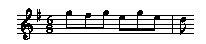
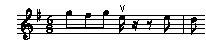
Unornamented score fragmentScore fragment ornamented with emphasis on first note and gap for breath

The first score is an unornamented bit of a tune. Although notating ornamentations is an approximation at best, I've attempted to express in the second version what I'm hearing on the recordings — a note is shortened but emphasized, the following note is gone altogether, and then the tune picks up after a rest.

If you're following along at home, now would be a good time to put on your favorite Irish flute CD, as it will probably give you a better impression of what I'm discussing than my clunky notation above.

An Ornamentation Approach to Learning to Breathe

Well, it's all fine and good to assert that breathing is an ornament, but it doesn't make it any easier to do, does it? After all, I can choose not to practice rolls until I get the fundamental rhythm of a tune right, but I can't choose not to breathe. It's a difficult thing, biology.

But maybe it does help. Because it suggests that what I said I found helpful last time:

So here's something which may seem obvious to folks who have played for a while, but took me a bit to realize: You can continue to finger the note as usual even though you don't blow it while you breathe. This way you're not disrupting the normal movement of your fingers during the breath.

...is profoundly wrong. There's a nugget of truth in what I wrote, I think: The reason I was losing the rhythm was that what was going through my head and what I was doing physically were different. But I picked the wrong solution. Instead of attempting to avoid changing what I was doing — and as I noted above, you can't avoid breathing — I should have been trying to change what I expected to play. I can play a tune better when I have an expressive version in my head.

It's not a magic bullet, though. I can do this well when I'm playing quite slowly, or if I practice breathing in a particular passage, but it's going to take some practice to be able to do it at will when playing quickly.

Conclusions

So the lengthy post above boils down to this:

  • I find it valuable to listen to good flutists on CD, and pay attention to their "breathing ornaments." I'm trying to get this ingrained in my head.
  • When I'm playing a tune and I need to breathe, I try and imagine the sound of the notes I'm about to play with this ornament. It make it easier to execute.
  • When I do this, I no longer get confused by not fingering the notes I drop. In fact, trying to finger them is confusing. It suggests I'm playing the tune mindfully instead of from muscle memory.

Sunday, June 12, 2005

Practice: Cut Slow

Another interesting piece of feedback I got in reference to my earlier post on learning to play tunes simply before adding ornamentation was this comment from "Sam_T" who noted that beginning pipers must use at least some ornamentation since they don't have the option of tonguing:

In practice, this means that you have to learn to use cuts and rolls from the beginning to get through virtually any tune. This might sound terrifying, but in fact just leads to different emphasis on learning. For example, the first tunes I was taught on the pipes were the Rambling Pitchfork, the Kesh and Garrett Barry's, all of which feature prominent rolls - this is precisely why they were chosen. Of course I played them VERY SLOWLY INDEED.

And this is just the point. None of the ornaments used in whistle playing are "difficult", in the sense of requiring any particularly complex motor skills to perform (although I might leave crans as an exception); it's not usually the movements themselves that cause the problem, but coordinating them at speed. Most people can play a perfectly good cut or tap in isolation, from the first time they pick up a whistle. The struggle comes in stringing them together. So the solution is to play slowly.

Another benefit of learning ornamentation from the beginning is that it gets you quickly out of the habit of gripping the whistle/chanter too hard. It's virtually impossible to play a good cut when you're hanging on to the instrument as if your life depended on it.

There's more good stuff in this post, so read the whole thing.

I'm practicing cuts on a couple of airs now, so it's natural to play them slowly. I think I might start the Kesh/Kerrigan's jig next, since L.E. McCullough has a number of variations of this one in his tutuorial, both simple and complex.

Monday, May 30, 2005

Practice: Making the Cut

I got some interesting feedback on my "No-Frills Whistling" post. I liked Steve's comment (and several others which echo its general sentiment), which reads, in part:

The passage you quote was written a few years ago and I've refined my thinking somewhat since then. I was really aiming it at people who get obsessed with more complex forms of ornamentation such as rolls and crans of various kinds before they can make sense of a simple tune - and I have come across plenty of such players of whistles and other instruments in real life and on the net. In that respect I stand by that passage.

Now however I would say that more basic devices that are commonly lumped under the heading of "ornamentation", especially cuts and to some extent taps, are indispensable and should be integrated into your learning of Irish music almost from the word go. If you don't learn them early you'll probably develop the habit of tonguing all over the place, a habit that is hard to undo once you've developed it. These devices then are not less important than good rhythm because they are more or less vital to developing good rhythm.

This is interesting to me, because once again I find what Steve writes lining up with my own gut instinct. I've learned a couple of tunes and am working on a third. Playing the same tunes over and over again gets a little tiresome, due both to repetition and the fact that my playing isn't quite as interesting to listen to as some of the CDs I own. I could start learning some new tunes, but that wouldn't necessarily make me a better whistler.

Another way to make practice more interesting, though, is to throw a new challenge into the mix. As I mentioned last time, Sheebeg Sheemore is a tune which really does benefit from cuts in a few places, and I tried that tonight. It's not so hard to play the cuts where I would normally tongue a repeated note, and it helps keep my mine focused on the tune.

I'm grateful to everyone who responded, because all of this is really helping to condense my thoughts about how I need to practice, what I wanted from the tutorials, and what I'd like to do with this weblog. In summary, I want to pass along useful advice from the point of view of a beginner, since most books seem to be written by experts.

More soon!

Friday, May 27, 2005

Practice: Learning from Mistakes

I have a couple of tunes under my belt now, and that makes sessions more fun, since I don't spend all of the time listening — just most of it! There are some obvious differences when you play with others, such as the fact that you have to pay attention to how other people are playing. Since I try to listen to myself and keep pace with my tapping foot, this is not entirely new ground. But when you're playing with other musicians, you can't fudge this — if you miss a note or take a long time to work out the fingering, they'll be into the next measure.

So the hardest thing for me right now when I'm playing with the session is picking up when I miss a note. I usually find myself having to wait at least until the start of the next measure and frequently longer before I can come back in, because I lose track of where I am in the piece.

One thing I've recognized is that this is essentially the same problem as breathing. As Brother Steve notes, a common way to take a breath is to drop a note. I've tried this and it's very hard for me, because it jars my rhythm. But keeping the beat while breathing is essentially the same problem for me as missing a note because I flubbed a fingering.

Ornamentation, too, presents a similar problem for me. As I noted in my last post, I'm working on learning to play tunes well without ornamentation before seriously working on adding trills and frills. But I've got Shebeg Shemore pretty much down and it really does sound better with cuts instead of tonguing in between the repeated notes, so I'd like to learn to do that. But again, the flying fingers are making it hard for me to keep time.

So my thought right now is that these problems are all related. So what to do about them? I'm not sure, but one thing which occurs to me is that I need to be stricter with myself about not letting the time slip when I'm doing my personal practice. I won't learn to do this right if the only time I ever practice it is in the couple of tunes I play at session.

I'm also thinking I should be starting to practice cuts and breathing in isolation. Maybe if the movements become as natural to me as hitting a specific note then it will be easier to avoid messing up my rhythm.