The Tannahill Weavers are taking requests for which tunes and songs they'll play on their next tour.
Their blog is worthwhile, too, since it features "Roy's Joke of the Week.
The Tannahill Weavers are taking requests for which tunes and songs they'll play on their next tour.
Their blog is worthwhile, too, since it features "Roy's Joke of the Week.
Every time I play this tune I ask what I've gotten myself into. With four parts, and some tricky fingerings, it's the hardest tune I play right now. That it lends itself well to speed doesn't help matters much. My teacher says it's a good tune for me to practice as it will help me clean up note transitions which involve moving most or all of my fingers at once, since there are a lot of those in this tune.
It's also a lot of fun to listen to. The Tannahill Weavers have an unusual but excellent arrangement where they play the tune through once, then sing Johnny Cope, then play the Atholl Highlanders again. You can hear this on their albums "Tannahill Weavers IV" and "Best of 1979-1989
I couldn't find a transcription I liked (read: one which sounded like what The Tannahill Weavers and my local session play), so I ended up making my own. It's a combination of ideas and phrases used in the following versions, plus what I hear on the cited recording:
[PDF]. In general when playing pipe tunes I like to look at the GHB scores. Note that GHB scores have no key signature since A mixolydian is the only choice on that instrument.Those who like dots can cut and paste this into Concertina.net's ABC Convert-A-Matic.T:Atholl Highlanders, The R:march M:6/8 K:A mix X:1 |:e3 ecA|ecA Bcd|e3 ecA|Bcd cBA| e3 ecA|ecA Bcd|eae fed|cdB A3:| |:Ace Ace|Bdf Bdf|Ace Ace|Bcd cBA| Ace Ace|Bdf Bdf|eae fed|cdB A3:| |:a2e edc|a2e edc|a2e edc|Bcd cBA| a2e edc|a2e edc|eae fed|cdB A3:| |:cAc cAc|dBd dBd|cAc cAc|BGB BGB| cAc cAc|dBd dBd|eae fed|cdB A3:|
Since this is a pipe tune I'm using cuts instead of tonguing to separate the (many) repeated notes. My teacher thinks this is excellent cut practice but too much from a listening point of view. I think it makes it sound more "bagpipey." There's probably a happy medium somewhere, but I don't have any recordings of the tune played on tin whistle for reference.
One of the fiddlers in my session plays an interesting variation in the last part. In the fourth measure of that part, he plays B2 B2 B2 instead of BGB BGB. This has the effect of disrupting the march beat and sounds pretty nice when only one person plays it and the rest of the session plays the tune as usual. However, it's too much, in my opinion, when the entire session plays that variation, in part because it's too disrupting to the beat and in part because it gets rid of the G natural, which gives the mixolydian mode its distinctive sound.
Despite being in 6/8 this is a march and not a jig, so it should have a march beat instead of a jig rhythm. I suppose you could play it as a jig if you wanted to, though.
Music theory geek digression: You occasionally see this tune scored in A major with accidental naturals on the Gs. I think that's incorrect, although I've seen an argument for the practice. Since we use the two-sharps key signature for tunes in E dorian, why use three for A mixolydian, which uses precisely the same notes?
 Colin Melville has played Highland pipes, Scottish smallpipes, and whistles for the Tannahill Weavers for five years. I spoke to Colin after their Saturday evening show at the 2005 Dublin Irish Festival.
The tape of the interview is quite noisy, so any errors in transcription are of course mine.
Learning to Whistle: Do you think there's any such thing as a "Scottish whistling style" (as opposed to repertoire), or is whistling pretty much wistling?
Colin Melville: I think the actual method of playing is pretty much the same for everybody. I think when you talk about Irish style or Scottish style or whatever else it's more with the material you're playing, and playing style is probably more down to the individual than the country you're from, I guess.
LTW: It does seem to be fairly common that a lot of Scottish whistlers are also pipers. How does piping affect your whistling?
CM: Well, obviously you use your fingers, so that's similar, but you know the scale is completely different. Obviously, with the bagpipes you've only got nine notes to deal with (obviously have a lot more on the whistle) and you have to learn a lot of new decorations. That's probably the toughest part, for a piper to change their decorations. When you first pick [the whistle] up you try and do the same things, but you have to start using tonguing and stuff like that. It's a different discipline.
LTW: How do you rehearse a tune where you use pipes and whistle at the same time? ...There's such a difference in volume...
CM: When we practice with the band — well, most practices — I usually use the [Scottish] smallpipes, in place of the Highland pipes just for that reason, in spite of the fact that it makes for a color difference acoustically. Other people can hear what they're practicing as well!
LTW: I've read that when you play the whistle and the Highland pipes together you use an E♭ whistle, but it looked like Phil was playing an A whistle tonight?
CM: No, everything we use in the band is all — well, because of the pipes being in B♭ — is tuned around that. There are capos on the guitar and the bouzouki, and the fiddle is tuned up. All the whistles and flutes are E♭ or B♭. The one which looked like A, that'd be a B♭, and then you've got the high E♭ and the low E♭s.
LTW: Right, because [the Highland pipes, which play a tone closer to B♭ when an A is fingered] are not concert pitch....
CM: Yeah.
LTW: In terms of playing the whistle, who are your favorite artists to listen to for performance ideas?
CM: I'd have to say Brian Finnegan. He's a star. I can't get my head around some of the stuff he does with it sometimes. With Flook, his band; they're great. You know, there's so many up-and-coming guys that play, a lot of them pipers... they're getting into different instruments. Findlay Napier (of Back of the Moon), I heard him recently playing the flute... absolutely fantastic. Finlay MacDonald, a great piper, he's also really good on the whistle especially.
LTW: Let's say you like to listen to Scottish music and you want to learn to play it; is there a "short list" of "core tunes" you might want to start with...? I'm not saying you need to list the tunes, but where would you look to begin with?
CM: It's kind of funny, when you go around Scotland, to different parts of the country, if you go down to sessions or if you play with local musicians, you do find that small regions have a set, "core tunes," but when you go to different regions there are different "core tunes." There are obviously some that transcend, but everybody has a set of tunes that they can easily play together. But it's funny, when you go to a different side of the country it's a different set of tunes. And that's the way that you find them. Most people, to find them, go to sessions, play with other guys, and you hear them all the time. I wouldn't say there are specific books or recordings that have got just these tunes in them....
LTW: ...because I look at the Tannahill Weavers and there are a lot of tunes which interest me, but you guys have [14] CDs, and...
CM: Yeah, where do you start? Funny enough, a lot of tunes that the Tannahills recorded way, way back, they're now very popular tunes, whereas when they recorded them they were unheard of.
LTW: I was trying to learn Tranent Muir by ear from your recording and play it on the whistle and I kept needing to go into the third octave....
CM: Very often you just make something up which sounds OK. The songs do tend to go way out, further than a whistle can, definately further than the pipes can. So you very often find yourself trying to stick as much as you can to the melody line but when it goes way above or below you just have to make something up!
LTW: You do [onstage] some fairly impressive feats of instrument changes [e.g., going from the whistle to the smallpipes to the Highland pipes, which requires strapping and unstrapping the smallpipe bellows]....
CM: [Laughs.] Not for the first time I've been caught out a few times — everyone's staring at me, and I'm... "What's wrong?" I'm supposed to be playing the smallpipes or something and I'm just standing there.
LTW: I know you guys recorded a tune from a Scottish whistle tutor. But I haven't seen that book in the U.S. Have you ever seen a whistle tutorial with Scottish music that you liked?
CM: To be honest, I kind of learned through sessions, and bands playing along. When I started playing folk music I was a piper, and I thought, I've only got a few sets [for the pipes]; I'd be sitting there the rest of the night, and I thought, I'm going to have to do something here. So that's how I started playing the whistle. Kind of unconventional roots. I have come across a few tutorial books over the years and they're varied in quality. You know, everyone has at least something that teaches you something new, so it may just be best to go out and buy a few of them, if you can find a few kind of cheap ones, then you pick up lots of little bits and pieces....
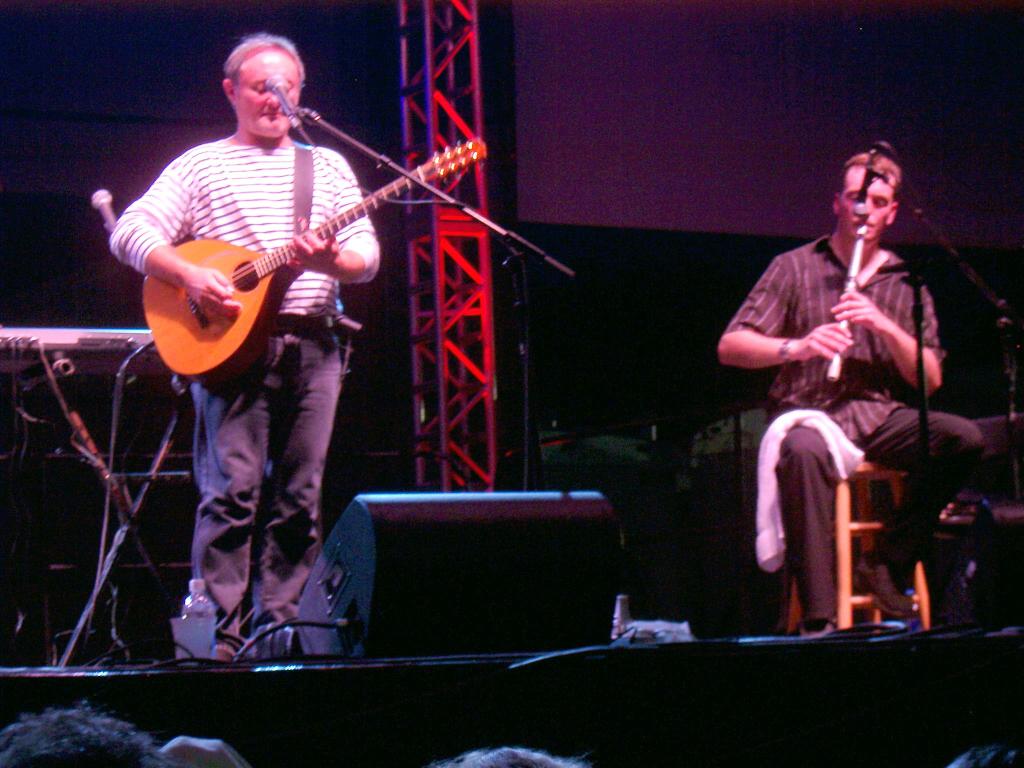 LTW: Can you tell me about the whistles you play; who makes them and what do you like about them?
CM: The low whistle I play is a Chieftan. I've been playing a low D Chieftan for a long, long time, and when I joined the band I just naturally got an E♭, because I'm just so comfortable with it. I recently ordered a set of high whistles from a guy called Chris Abell, from North Carolina. So you get the same head with the E♭, the D, and C bodies, and I just think they're wonderful. I just got them a couple months ago, and you can really hear them coming in now; they're starting to get "played in." They're just a joy to play. I definately recommend them. We also use the cheap ones; the B♭ one we use is just the Generation. You have to go through a box of them; you have to find a "good one," to spend time going through them.
LTW: How do you orchestrate a tune, decide which instruments you're going to put to it? Is it trial and error or...?
CM: Trial and error to a certain extent. There's a format we use very often on stage. You know, you're not going to put the bagpipes in at the start and play the small whistle at the end because of the power of the bagpipes. You should put them at the end if you're going to put them in a song; you get that blast. As far as choosing my instruments, trying to decide whether to play the whistle with the smallpipes, or the high whistle with the smallpipes, that part usually depends on what Phil is doing, if he's playing the flute and whistle as well. Two whistles together sound lovely; you can throw lovely harmonies in. But if I'm playing smallpipes and he's playing whistle it gives you more freedoms; you can mess up and get away with it! With the same instrument you notice every little — if somebody does something slightly different you can hear it. When playing different instruments it gives you a little bit more of a free reign with what you're doing. So that's something to barter.
LTW: What's it like to join a band that has three decades of history behind it before you came on?
CM: Yeah, it's pretty weird. It's pretty weird. It's great, you know. I was just handed this opportunity... Do you want to join the Tannahill Weavers? "Hmmm... Let me think about that..." [Laughs] Well now I've put in five years and I'm quite comfortable with it. At the start it was quite, quite daunting.
LTW: Did you have to study all their old material, to pick up the tunes?
CM: Yeah, yeah. I knew the piper who was before me in the band; he was very helpful with it. It made things a lot easier because he spent a lot of time going through the material with me. In the first gig — actually, I just remembered that — the first gig I did with them was in Germany, and I only met Roy the afternoon of that gig; it was the first time I'd met him. [Ed. note: Roy lives in the Netherlands.] Up until then we'd just been practicing to tapes and things. That was pretty weird. I was pretty nervous about it, but it all went well I think. I'm still with them so I must be doing something OK.
LTW: It seems like you're doing quite a lot. You're not just piping; you're involved in the production and [writing] the music....
CM: Yeah; that's a really good opportunity for me because the band records — well, we usually do it on our own — so we do a lot of the recording and then there's a sound engineer who comes in and helps us with it. Because if you're in a commercial studio you're really pushed for time; it's all money, money, money. But because we have our own little place we can sit and take our time, follow our ideas and mess about with things.
LTW: Roy told me that you guys never perform The Great Ships live, and I'm curious: Are there songs that just can't be done live, or...?
CM: Yeah, there are some songs that are more difficult to come up with a live arrangement. Just for an example there are a lot of songs and tunes that John plays cello and viola — all sorts of "stringy things!" — and he can't do that live and some things that there'll be a kind of technical part in the arrangment and that becomes a lot more difficult. You have to come up with a new arrangement basically to do that live. We like to do things live pretty much the way they are on the CD.
LTW: Do you have any good stories from your tour?
CM: [Laughs] Uhhh.....
LTW: ...any you're willing to repeat?
CM: Yeah, exactly! Here's a funny one: Coming through customs, coming into the country, just last weekend. John the fiddler, he came up to the guy; you know, you get a little interview. The guy says, "What are you doing here?"
"I play in a band."
[The customs inspector asked] what kind of band, what kind of music do you play, what instrument, and all that, and they're chattin' away, and [the inspector] is writing on this form, and he looked at John, and said, "So, your occupation would be...?"
John said, "Musician."
[The inspector] went to write it and he looked up at John and said, "Umm... I'll just write fiddle player; it's easier to spell."
It's true! Incredible, but true.
That will get me in trouble; I'll get pulled aside on my way out of the country!
Tranent Muir is the lesser known of two ballads by Adam Skirving about the Battle of Prestonpans; Johnny Cope is the other. The Tannahill Weavers have recorded both of them, although their version of Tranent Muir includes only six out of fifteen verses of this long and graphically violent song.
Both songs are discussed in Michael Brander's Scottish and Border Battles and Ballads
 In the summer of 1745, Prince Charles Edward Stuart, commonly known as "Bonnie Prince Charlie," mounted a campaign to take Scotland with an eye towards reclaiming what he considered to be his throne. Against long odds, and aided by the early support of Donald Cameron of Lochiel, chief of Clan Cameron, his party of ten raised an army which eventually numbered over 2000 Scots as they marched to Glenfinnan and then to Edinburgh.
Sir John Cope, the general commanding government forces in Scotland, was commanded to raise forces to stop the rising. He did so, but the vast majority of his recruits had no experience whatsoever, and he was hampered by a variety of other issues including the sickeness of his principal cavalry officer. Despite this, the officers apparently believed that the rebels would never attack a single force including both infantry and cavalry. They assured locals during their march that there would be no battle. In this they were almost right, but they incorrectly identified which side would back down! Skirving references this claim in verse three:
The bluff dragoons swore, blood and oons!
They'd make the rebels run, man:
And yet they flee when them they see,
And winna fire a gun, man.
Charles's army took Edinburgh with little or no fighting on the 16th of September; Cope, travelling by ship from Aberdeen, arrived too late to challenge them.
On 20 September Cope's forces encountered Charles's advance guard. Cope decided to stand his ground and engage the Jacobite army. Cope kept fires burning and moved his forces during the night as the Highlanders advanced under cover of darkeness. At the crack of dawn on 21 September 1745, Cope's dragoons beheld the spectacle of 1400 charging Highlanders accompanied, according to Brander, "by wild Highland war cries and the bloodcurdling skirl of the pipes...."
Cope's inexperienced army fled, despite Cope and his officers attempting to force them to charge at pistol point. The "battle" was over in five minutes with close to 1000 government troops killed or wounded and 1500 held prisoner. The Highlanders suffered only around 100 troops killed or wounded.
Despite the overwhelming defeat and the fact that Cope had to report it personally to the garrison commander at Berwick, 50 miles away, Skirving's lyrical accusations that Cope himself fled the battlefield appear to be incorrect. Cope and his officers were exonerated at court-martial. Martin B. Margulies, writing in History Scotland, notes:
The Report of the board's proceeding was published in 1749. Anyone who scrutinizes it closely can only conclude that the board was correct. What emerges from the pages is not, perhaps, the portrait of a military genius, but one of an able, energetic and conscientious officer, who weighed his options carefully, and who anticipated - with almost obsessive attention to detail - every eventuality except the one which he could not have provided for in any case: that his men would panic and flee.
It seems, then, that the two songs tell us as much, if not more, about Skirving himself as they do the battle. Brander writes that Skirving visited the battlefield in the afternoon, long after the conclusion of the battle itself. In the midst of that garish scene, he was by his own account mugged by the victors.
Verse nine features one Lieutenant Smith:
Lieutenant Smith of Irish birth,
Frae whom he call'd for aid, man,
But full of dread, lap o'er his head,
And wadna be gainsaid, man.
Bender writes:
Lieutenant Smith... incensed by the publication of the comments on his behaviour visited Haddington subsequently and sent Skirving a challenge to a duel. The latter pawkily replied that he was too busy on his farm. "Gang awa back," he said, "and tell Mr. Smith I havena the leisure to come to Haddington; but tell him to come here and I'll tak a look o' him and if I think I'm fit to fecht him, I'll fecht him; and if no, I'll do as he did — I'll rin awa."
I've experimented with playing the song on the whistle — at least, the tune as the Tannahill weavers play it; I presume that they are playing a traditional melody rather than one they wrote themselves. I haven't yet managed to find notation for Tranent Muir, but I've tried to play it by ear and find that I keep needing to go up into the third octave on the whistle. When I saw them perform at the 2005 Dublin Irish Festival, Phil did play the whistle but stopped playing during the highest part. But if the tune can be adapted for Scottish smallpipes, with their much more limited range, then I'm sure there's a way to do it on the whistle; I just haven't figured it out yet.
There is an ironic musical postscript to Tranent Muir: In spite of his decisive victory at Prestonpans, the tables were soon turned on Bonnie Prince Charlie and his half-starved army was defeated at the Battle of Culloden. He escaped Scotland, spending the remainder of his life in exile. His flight is commemorated in the Skye Boat Song.

I've been a fan of the Tannahill Weavers since first hearing their "Lucy Cassidy" set on a RykoDisc sampler back in the late '80s, but I've been listening to their recordings with a bit of a new ear since taking up the tin whistle. But I'd never had the opportunity to see them perform live.
So I was delighted when I learned that they would be coming to the Dublin Irish Festival. I also requested an interview with the band, and Colin Melville soon agreed to spend some time discussing whistling in Scottish music; I've posted the interview separately. The band played three sets at the festival; I caught them on Saturday and Sunday.
The musicians in the Tannahill Weavers have changed over the band's 37 year history, but Roy Gullane (guitar, vocals) and Phil Smillie (simple system flute, whistle, bodhrán, vocals). Colin Melville (Highland bagpipes, Scottish smallpipes, whistles) is the most recent addition; he's been in the band for five years. Leslie Wilson (bouzouki, keyboards, vocals) and John Martin (fiddle, vocals) have both been in the band for over 15 years.
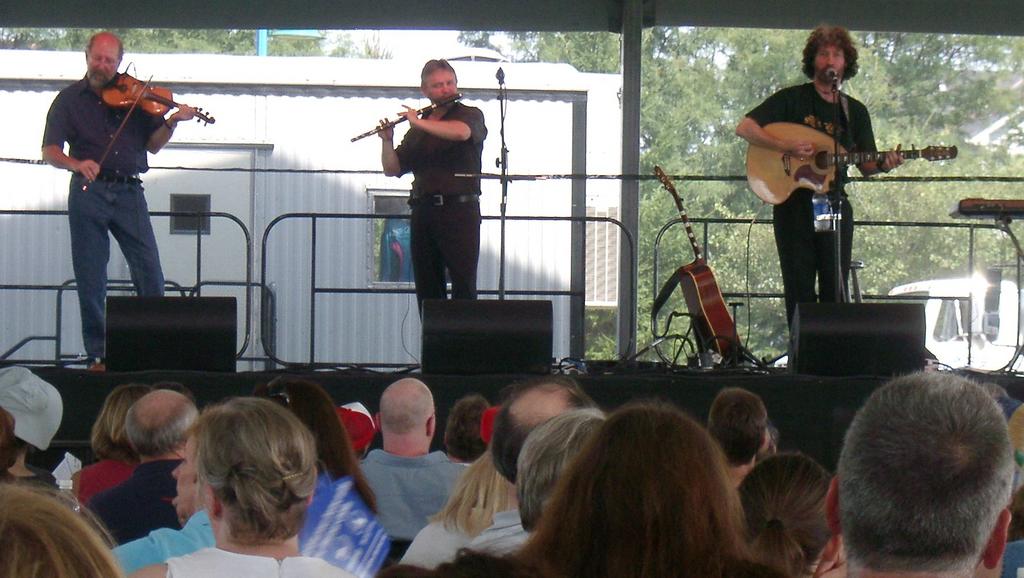 I was wondering what a band with 14 full albums (not counting compilations) to its credit would play in concert, and it turns out that their taste is pretty similar to mine, as they played most of my favorite tracks! They played music from across the history of the band, including several spectacular sets of dance tunes like The Geese in the Bog / The Jig of Slurs and the Arnish Light set. I really like their new version of Cam' Ye By Athol; they first recorded it on Are Ye Sleeping Maggie, but rearranged it on Arnish Light to include a Highland bagpipes bridge. They played two songs by Adam Skirving about the Battle of Prestonpans: Tranent Muir and Johnny Cope. Of the battle itself, Roy quipped, "...the most famous battle in Scottish history, because we won it."
Roy's inter-song chats were very much in the spirit of the Tannahill Weavers's frequently amusing liner notes (all of which you can read online). Here's one of the stories he told:
Two men were out fishing in the middle of a lake when a bottle floated up to the boat. One of the men leaned over and opened it and a genie floated out of the bottle. "I'll grant you one wish," said the genie.
"Don't I get three?" asked the man.
"No, only one," replied the genie.
"OK," said the man. "I'd like you to turn entire lake into whisky." There was a poof, his wish was granted, and the genie disappeared.
"You idiot!" screamed his companion. Now we're going to have to wee in the boat!"
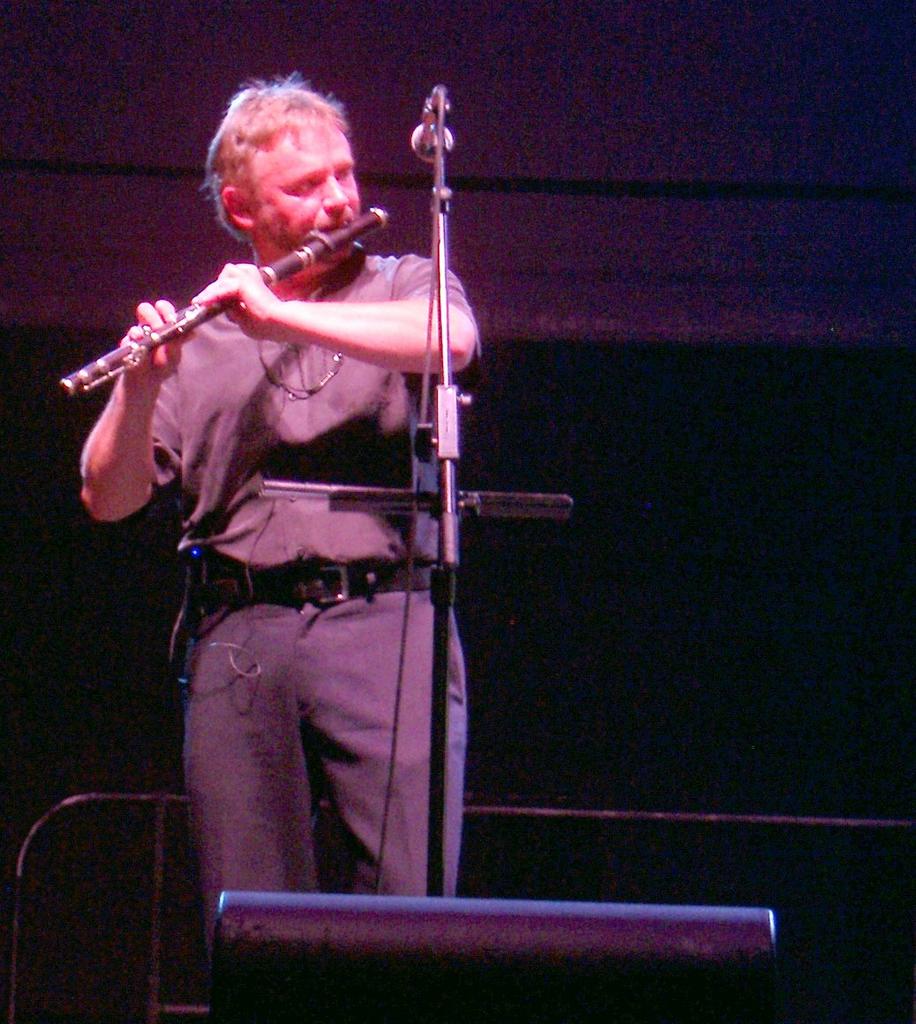 The Tannahill Weavers were the first successful Scottish folk band to use the Highland bagpipes in a band setting, and their unusual tuning poses certain difficulties for whistle players. When Colin is playing the pipes the rest of the band has to adapt to this, especially when playing a diatonic instrument such as the whistle. Phil plays an E♭ flute with keys, and a B♭ whistle. When Colin is playing the whistle he is of course not piping and plays high and low E♭ whistles.
At one point I was watching Phil whistle when I saw him repeatedly lift his right hand and start tapping it on top of his left hand as he played. I couldn't tell what he was doing, but I overheard another whistler ask him about this after the show and leaned in to hear the answer. "It's just a trick," he said. He plays a very fast fingered vibrato by running the first three fingers of his right hand, with a little space in between them, across the second or third finger of his left hand, which has the effect of quickly drumming the left-hand finger against the whistle hole.
It wasn't the only unusual technique observed that evening, either; at one point Roy played his guitar with a violin bow. It was also interesting when Roy stopped playing his guitar or when Les played the keyboards. This allowed me to hear the guitar and bouzouki in isolation, which normally intermingle. The Tannahill Weavers are so tight as a band and their performances are so well-arranged that it's interesting for me to try and pick them apart and identify the individual elements which make up the overall sound.
The Tannahill Weavers played for just over an hour and a half on Saturday night. The set list was substantially similar to Saturday's but reduced as the band had a shorter time slot. Sunday afternoon I brought my three-year-old daughter, also a fan of the band, to see their third show. We were a little disappointed that they didn't perform "The Great Ships" — which my daughter has memorized and likes to sing along to — but Roy told me after Saturday's show that it's one of the songs they don't ever play live. [Colin later told me why.] Nevertheless my daughter really enjoyed the show; in spite of the volume and having a three-year-old's attention span she wanted to stay for the entire show.


