Monday, November 14, 2005

Seisiún: Off to California

I'm in Scotts Valley, CA for a week to meet with some folks at Borland, and as I had a free day yesterday I decided to look for a session. It turns out that there are quite a few sessions in the Santa Cruz area but the only one I could make during my trip was the second Sunday slow/intermediate session meeting at the Britannia Arms Pub in Aptos.

Like the session I attend in Columbus, it was very friendly, somewhat informal, and welcoming to beginners. When I entered the pub I sat down outside the circle to try and get a feel for the session before joining in. Someone spotted my whistle case, however, and asked me to join almost as soon as I sat down, and then almost immediately invited me to start a tune. I found it to be a very welcoming group. As chance would have it, I had attended Sunday services at the Unitarian Universalist church in Aptos that morning and found it to be a very outgoing and warm group as well, so maybe there are just a lot of nice people in the Aptos area....

But there were differences from the Columbus session, as well. For one thing, the mix of instruments was different. In Columbus we have enough fiddles to stock a symphony orchestra, whereas there were only two fiddlers in Aptos, but three people played mandolins, making them the most common instrument in the session. Someone also brought a cello, which was neat. More significantly (though not surprisingly), the tunes were different. I recognized nearly all of them, but even when I knew how to play the tune they sometimes played it differently; the folks in Aptos play Sí bheag Sí mhor with repeats, whereas I've always played it straight through. It threw me off a bit until I figured out what they were doing, and then I could keep up. When I was invited to start tunes it took a little comparison of notes to find some that both I and the rest of the session knew, but after some discussion I ended up starting Harvest Home and the Swallowtail Jig.

This was the first time I've attended a session while traveling, and it was a great experience, both because the folks in the session were so nice and because it was challenging for me to keep up with musicians who do things differently than I'm used to. That's a good thing; it's always good practice to listen. I'm certainly going to seek out sessions when I travel in the future.

Anyone know of a session meeting next week in Santa Fe?

Wednesday, November 09, 2005

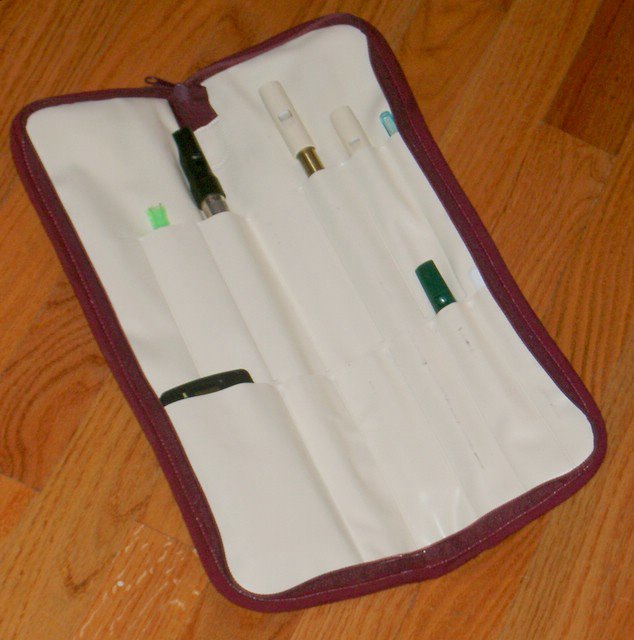
Shopping: A Cheap Case for My Cheap Whistles

My wife, who knits, and loves me, suggested that a knitting needle case might work very well for storing whistles. I purchased one from Joann Fabrics. It has enough pockets to hold three or four metal whistles, but probably wouldn't fit wood or plastic whistles. The slots in the case are also too small for anything pitched lower than soprano D. It also holds my tuner, extra fipples, and accessories. The outside of the case is quilted fabric, and the inside is plastic. There is a zipper around the outside to close the case.

You can click on the pictures to enlarge them.

The case normally costs $14, but it's pretty easy to find coupon codes for Joann.com; just check back regularly enough and you'll find a code for 40-50% off on the home page.

This case suits me well since I play cheap whistles. If I played $200 whistles I'd probably want something nicer.

I've also been told that drum stick bags make good, cheap whistle cases. You can impress your seisiún with a coffin case for your whistle.

Update: The Whistle Shop is now selling a couple drum stick bags as whistle cases. They're a bit more appropriate, I think, than the "coffin" style mentioned above.

Tuesday, November 08, 2005

Personal: Sunflowers

A snapshot from a pumpkin-picking trip.

Tuesday, November 01, 2005

Practice: Dog Panting

At my last lesson my teacher asked me, "Do you [when not playing] think a lot about breathing?" I told him that yes, I do.

Ornamentation semantics

We talked for a while about the "breathing as ornamentation" idea expressed in that post. He both agreed and disagreed, the distinction being how you define "ornamentation." I could say that ornamentation means:

  1. Any conscious modification of a tune or deviation from the printed score.
  2. Any modification intended to call attention to itself in some way; a flourish or filigree.

My teacher feels that although you frequently drop notes while breathing that doesn't mean the gap has to be long or obvious. So it's an ornamentation in the sense that it's a change to the melody but not an ornamentation in the sense that it isn't really supposed to stand out. I can go along with that. But then again, I find that in general my favorite ornaments to listen to are the ones that don't really stand out.

Diaphragmatic breathing

As I learn to play tunes faster, I need to breathe faster, too. How can I learn that? My teacher wants me to focus on using my diaphragm.

Folks who have studied experiential anatomy (or maybe just classical flute) know that there are many different "methods" of breathing. You can breathe in by expaning your chest or contracting your diaphragm. The latter is advantageous for flute and whistle as you can move more air faster with your diaphragm than with your chest. Also, breathing this way won't move your shoulders, which interferes with how you hold your instrument.

We tried a couple of exercises to help me learn to focus on the diaphragm while breathing:

  • Put your hand on your diaphragm; it's just below your belly button. Breathe, and try to feel the muscle in action.
  • Pant like a dog, really quickly. You'll have to use your diaphragm, because it's the only way you can breathe that fast.
  • You can find more exercises on this page if the previous two are not enough.

I also found this old chiffboard post by David Migoya which concisely expresses something I've noticed while practicing the whistle:

Part of the key to good diaphram control is the use of the nose. Not only should you know how to take in breath through both the mouth and nose while you play, but you should know how to EXHALE through your nose WHILE you play. This gets rid of "stale" air and greatly increases the capacity of your body to take in fresh air for playing. I don't do this a lot on the flute, but I use it quite a bit on the whistle as I'm not using near as much breath.

I've found that if I'm not careful about regulating my breathing I can have too much air in my lungs and this makes articulation difficult. But I can breathe out through my nose while playing to get down to a more comfortable volume of air.

Saturday, October 22, 2005

Recordings: Pooh - Friends Forever

Although my daughter has excellent musical taste, we do from time to time buy or borrow so-called "children's music." And although a great deal of it is, well, horrible, and never gets played again after the first listening, there are exceptions. So the other day my wife tells me that she's picked up a Winnie-the-Pooh CD at the library with some tin whistle on a couple tracks, and our daughter likes it. Sounds interesting, but I didn't think much of it. Then a couple days later we're riding in the car and she puts the CD, called, "Pooh - Friends Forever" on.

Well, yes, there's tin whistle, but there's also Uilleann pipes, simple system flute, they're playing a jig, and when I pick up the CD I see that track 13, "Reel Friendship," is performed by Solas. Solas on a Pooh CD?!? How weird is that? Even stranger, you'd hardly know it to look a the CD. Solas is mentioned in tiny type on the back. Most of the musicians are uncredited. The folks from Solas are credited, as are some of the vocalists — sort of — but it's not at all clear who plays most of the instruments on the CD or even who wrote the songs. Do John Doyle and Winifred Horan play only on the single Solas track? Someone with a better ear for style than I posess will have to answer that. Seamus Egan is credited for playing the bodhran — only! All in all it's an odd little find.

Not all of the CD is ITM. Granted, ITM doesn't generally feature Tigger on vocals, but some of the tracks are a bluegrassy version of what you've come to expect from "Pooh songs" if you've seen a few of the Disney movies. That doesn't make them bad, however; the whole CD is a cut above the typical Disney soundtrack.

You can hear samples of the CD at the Amazon page.

Wednesday, October 19, 2005

Practice: Hard Wired Foot

Changing how I tap my foot turns out to be extremely difficult! It's hard to think about that and whistle at the same time, so I've been doing it while humming or listening to CDs. I also worked on this when I went to my local session last week (at least, when I wasn't playing). Someone later told me that I looked like I was really concentrating....

I can sorta do it for the first part of the only reel I know right now (my session seems to lean heavily towards jigs and hornpipes, so that's mostly what I've been learning) but I have to think about it a lot. I haven't begun to deal with the issue which caused me to need to do this, which is getting the swing of a reel right. I think I need to wait until the toe-tapping comes as naturally as it used to before I can do that.

Tuesday, October 11, 2005

WWW: Nude Pipe and Whistle Calendar

The calendar you've always wanted but have never thought to ask for is now on sale. But the effort did not come without certain technical difficulties:

Following the success of the previous two years (the 2004 nude accordion calendar "Pulling Out All The Stops" and the 2005 nude guitar calendar "No Strings Attached"), the Folk Arts Council Board decided that in 2006 we should buff up with bagpipes and whistles – undoubtedly a more challenging proposition for intrepid photographer Sheilagh O'Leary. The average tin whistle might not be up for the job of hiding someone's private parts, even if a low D whistle is used!

Sales benefit the St. John's Folk Arts Council, for those needing to justify the charge to their spouse.

Tuesday, October 04, 2005

Technique: Tapping Out a Reel

For the last three weeks I've been trying to avoid learning anything new.

More precisely, I've been practicing the tunes I've learned thus far, focusing on performance. My renditions of several of the tunes had become a bit sloppy, and my teacher asked me to focus my practice on playing the tunes well rather than new tunes or techniques. It was timely advice.

One of the things I noticed when I stopped making as many mistakes and got my timing more consistent is that a reel I've been learning, the Five Mile Chase started sounding really mechanical — like a string of eighth notes rather than a reel. This was very similar to a similar problem I had with jigs which I'm presently working on correcting. I made a note to bring the issue up with my teacher and expected a similar solution.

Interesting advice

I had a lesson last night, and his suggestion surprised me a little. Yes, I need to emphasize notes differently depending on their position in the measure. But the best way to fix this, it seems, is to change the way I tap my foot.

I doubt I would have come up with that one on my own! Part of his advice has to do with counting in cut time instead of common time. But part of it is literally changing the physical way I move my foot. I'll treat both issues separately.

Reel beats

It's common to see reels notated in both common (4/4) and cut (2/2) time. In both common and cut time there are the same number of quarter notes per measure, so the note values won't change if you move from one time signature to the other. But it's generally understood the music in cut time is played faster, since there are half as many beats to count. Also, the emphasis is different: You emphasize the notes which fall on a count more than those which do not, so fewer counts means fewer emphasized notes.

On the subject of how to notate a reel, Alan Ng writes:

A group is defined here as a sequence of notes whose first note is synchronized with the (main) tap of the musician's foot in a traditional performance.

Reel: Two groups of four notes each, adding up to an eight-note bar. Within each group there are two heavy-light pairs. Accordingly, I notate reels in 2/2 meter, not in 4/4. A 4/4 notation is a less accurate reflection of the traditional sense of rhythm in a reel...

Well, the "traditional sense of rhythm in a reel" is exactly what I'm aiming for, so Ng's advice is in line with my teacher's in that respect. I confess that when I started playing the whistle I'd sometimes count reels notated in cut time in common time instead, simply because my playing was so pathetic that I'd lose track of the beat if I had to go four notes in between taps. But I'm past that now!

Methods of foot tapping

I've been involved in making music in one capacity or another for over 15 years now, and it had never before occurred to me that there are different methods of tapping your toe. But there are, and it's quite enlightening to ponder.

What I had been doing is holding my toe off the ground and then tapping it onto the ground on each beat. This is quite tiring, so I tend to switch feet when my leg gets tired. My teacher's first suggestion was to keep my foot on the ground and lift it up before the beat, bringing it to the ground on the beat, and keeping it on the ground until just before the next beat. This is a different sense of rhythm than I'm used to, and it's going to take some practice.

For a reel in cut time, he suggested lifting my foot off the ground on the half beats (what would be the 2 or the 4 beats if the same passage was notated in common time) and bringing it to the ground on the full beats (the 1 and the three in common time). Again, I'm going to have to practice this while listening to a CD or humming before I can even try this while playing.

Counting this way makes the beats to emphasize quite similar to a jig. Handy, that.

Time to practice

I ususally have lessons every two weeks, but due to circumstances it has been three weeks since my last lesson. I don't mind that a bit; it gave me lots of time to practice and listen to myself. We tried lessons every week for a while, but that was too often; I didn't have time to practice what we'd discussed the week before. Sometimes less is more.

Saturday, October 01, 2005

Practice: Not Too Late

This is a small thing, but it makes a big difference for me: Since I have a full-time job and a family, I tend to practice in the evening. Sometimes night. But I've found it's really worth the effort to practice as early as I can. 8:00 or 9:00 at night is fine. But at 10:00 or later I'm really too tired to focus. Practice is much more satisfying when I'm not too tired to concentrate.

Similarly, I can't practice well if I'm stressed out or have other things on my mind. This all might seem kind of obvious, but it was easy for me to allow housework to push my practice sessions very late, and I've now made a point of practicing first, since my housework doesn't suffer nearly so much for me being tired or distracted.