Friday, September 23, 2005

Recordings: New CTL Next Week!

When I reviewed Cherish the Ladies's show at the 2005 Dublin Irish Festival a while back, I raved about their new vocalist (and bodhrán player), Heidi Talbot. Unfortunately, the only CTL CD she's appeared on thus far has been On Christmas Night, and I've had a permanent nervous reaction to Christmas Carols due to overexposure to Muzak when I worked in a grocery store in high school (the drugs and therapy have helped quite a bit, thank you).

So it's wonderful to see that CTL has a new album, Woman of the House, due out 27 September which features Ms. Talbot and is Irish / Celtic music from start to finish. You can hear samples from every track on the album today on the linked Amazon page. It would probably be premature to call this the best CTL release ever before I can hear the entire CD instead of just excerpts from each track. But it's really good!

[It's a dollar cheaper to buy the CD directly from the record label, but the label really kills you on the shipping charge, whereas you can get free or cheap shipping from Amazon, depending on how much you buy. But take your pick.]

Wednesday, September 21, 2005

Technique: Learning to Breathe

For me, learning how to breathe without breaking the rhythm of a tune is not easy. I've written about this before, but in the months since I wrote that post I've changed my conclusions.

Breathing as Ornamentation

I've explicitly discarded an assumption which I didn't write about at the time and might not even have been conscious of when I wrote the previous post. As a beginner, my instinct was to try and make breaths as inconspicuous as possible. The trouble with that notion is that "as inconspicuous as possible" is still pretty conspicuous!

I don't think there's any way to play a quick tune (or at least most tunes) in such a way that the listener can't tell when you breathe. Certainly, it isn't difficult for me to hear very good whistlers taking breaths when I listen to CDs. Circular breathing is for didgeridoos. So if we accept that there will always be an audible gap in the music when we breathe (unlike, say, the fiddle or the pipes), then instead of hiding the gap in the tune altogether we must make the gap appropriate for the tune. Turning lemons into lemonade, as it were. A well-placed gap for a breath, in other words, is an ornament, a variation in the tune which adds musical interest.

One good way to learn about using this form of ornamentation is to listen to recordings of Irish music on the flute. Flutes require a lot more air than (soprano) whistles, so the players have to breathe more. Hence, you have a lot more opportunities to listen for this in a flute passage.

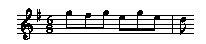
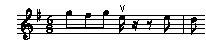
There's an ornament I've always liked that I hear most prominently on flute recordings, but you can hear in whistle recordings as well, where a player shortens a note and skips one or two notes which follow. I'm embarassed to say that it didn't occur to me until recently that this was not merely done for style but that the player was breathing as well! In case it's not clear what I'm referring to, consider the following two score fragments:

Unornamented score fragmentScore fragment ornamented with emphasis on first note and gap for breath

The first score is an unornamented bit of a tune. Although notating ornamentations is an approximation at best, I've attempted to express in the second version what I'm hearing on the recordings — a note is shortened but emphasized, the following note is gone altogether, and then the tune picks up after a rest.

If you're following along at home, now would be a good time to put on your favorite Irish flute CD, as it will probably give you a better impression of what I'm discussing than my clunky notation above.

An Ornamentation Approach to Learning to Breathe

Well, it's all fine and good to assert that breathing is an ornament, but it doesn't make it any easier to do, does it? After all, I can choose not to practice rolls until I get the fundamental rhythm of a tune right, but I can't choose not to breathe. It's a difficult thing, biology.

But maybe it does help. Because it suggests that what I said I found helpful last time:

So here's something which may seem obvious to folks who have played for a while, but took me a bit to realize: You can continue to finger the note as usual even though you don't blow it while you breathe. This way you're not disrupting the normal movement of your fingers during the breath.

...is profoundly wrong. There's a nugget of truth in what I wrote, I think: The reason I was losing the rhythm was that what was going through my head and what I was doing physically were different. But I picked the wrong solution. Instead of attempting to avoid changing what I was doing — and as I noted above, you can't avoid breathing — I should have been trying to change what I expected to play. I can play a tune better when I have an expressive version in my head.

It's not a magic bullet, though. I can do this well when I'm playing quite slowly, or if I practice breathing in a particular passage, but it's going to take some practice to be able to do it at will when playing quickly.

Conclusions

So the lengthy post above boils down to this:

  • I find it valuable to listen to good flutists on CD, and pay attention to their "breathing ornaments." I'm trying to get this ingrained in my head.
  • When I'm playing a tune and I need to breathe, I try and imagine the sound of the notes I'm about to play with this ornament. It make it easier to execute.
  • When I do this, I no longer get confused by not fingering the notes I drop. In fact, trying to finger them is confusing. It suggests I'm playing the tune mindfully instead of from muscle memory.

Thursday, September 15, 2005

WWW: Open Directory Tin Whistle Category

The Open Directory is a community effort to build the world's largest human-edited Web directory. The tin whistle category was pretty badly out of date, so I volunteered to edit it, and my application was accepted yesterday. I've just started working, and it will take me a while to get everything in order, but I have managed to go through the backlog of submissions and publish those which fit the category. (Note that if you're an instrument builder I've published your link in the Tin Whistle/Makers category and if you run a store then you should be listed in /Shopping/Music/Instruments/Winds/Tin Whistle/, which I don't control.)

But this is just a start. My goal is to build the most comprehensive index of tin whistle links on the Internet, and you can help! There are many sites I haven't had a chance to look up and add, and more I'm simply unaware of. Do you know of a whistle-related site not currently listed? General sites, links to instrument makers, tune lists, and performers are all fair game. Find the appropriate category and use the "suggest URL" link at the top of the page to let me know. I want to build a useful resource for the tin whistle community.

Note that it takes a few days after I've added a site for it to become visible to the public, so please have patience after you submit.

Tuesday, September 13, 2005

Books: Last Night's Fun

Ciaran Carson is the director of the Seamus Heaney Centre for Poetry at Queens University Belfast, an author of several books of poetry and prose, and a winner of the T.S. Eliot Prize for poetry. He's also a flutist and tin whistler, and, from the sound of things, has spent much of his life driving around Ireland and America, playing with sessions, picking up hitchhikers, and sampling the poteen. In Last Night's Fun he improvises around these ideas in a literary analogy to ornamenting a tune.

The book is a collection of essays, each named for a tune. The style ranges from poetry to prose to collage, from historical to hilarious, with a healthy dose of autobiography. Essays which don't consist in their entirety of extracts from works by other authors are frequently salted with lengthy quotes. The poetry is mostly Carson's own, but there are a few poems from John Loughran, and one from Séamus Ennis(!).

It is often observed that Irish music is a living tradition best learned and experienced live, but attempts to explain why this is so to the spectator not familiar with the experience often fall short. Last Night's Fun tests the limits of printed material in relating the experience of playing in a lively session, along with the music and lifestyle of the ITM community.

Here's an excerpt:

We were all apprentice Druids then, I think, led by the resident genius of Mick Hoy the fiddle-player. Stuck out in the starving wilderness, deprived of supermarkets, we'd improvise cuisine from sorrel, chickweed, nettles, mucshrooms and wild garlic, inspired by the arcane herbal forage-knowledge of Gary Hastings. Soup was made in a vast antique cast-iron stockpot, and in the morning you would find the aluminum ladle standing vertically in a green glue residue.
Time got out of mind as last night's fun embraced the next hungover morning and we staggered out again into the dawn of afternoon to hunt for wild herbs. We were oxymorons, children of the Sixties caught in a Celtic time warp where tunes were handed on by fairies or acquired in dreams: dimly sceptical of magic, we found ourselves surrounded by it, and the old tunes we learned from Mick became our conversation. Even the new tunes, like 'The Floating Crowbar' (I have heard it attributed to the fiddle-player Brendan McGlinchey), corresponded to a neo-Druidic sympathetic magic, where — so the story goes — the forged-steel murder weapon ditched in the river floated to the surface with the blood and hair of the victim still clotted to it. The reel took on the antique connotation of a Grimm's tale, with its talking horse's head that revealed the nub of the story in a cryptic rhyme. Mick would tell us tall tales....

Monday, September 12, 2005

Seisiún: Bardic Circle at Amore Restaurant

Bardic Circle session will play again at Amore Restaurant in Westerville, Ohio, from around 8:00 - 11:00 p.m. on Thursday 15 September 2005. Look at my previous post for directions.

You can come join the session, dance, listen, or just eat!

Friday, September 09, 2005

Tunes: The Galtee Hunt

This is my favorite hornpipe. I first heard it on Kells' excellent CD "SuR;" the liner notes describe it as a "very well-known hornpipe," but nobody in the Columbus, Ohio area seems to have heard of it. So I've made it my mission in life (well, in ITM anyway) to promote the tune.

Clannad have also recorded this tune; it's on Dulaman and some of their compilations. I like Kells' recording most, but Clannad's version is also good.

Monday, September 05, 2005

Shows: 2005 Dublin Irish Festival

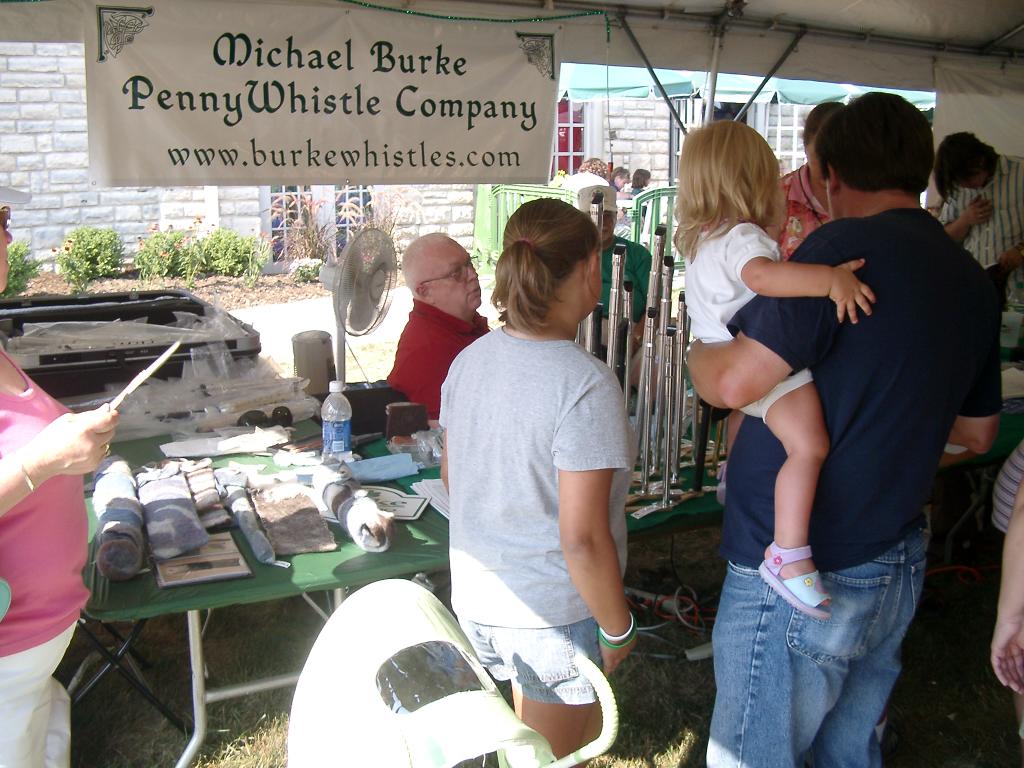
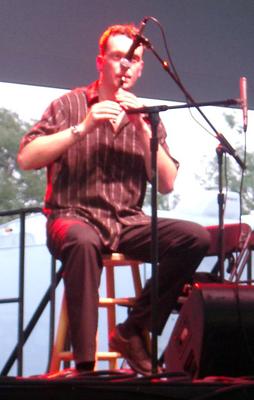
Michael Burke sells his wares in the music vendors' tent.

This is an index to my other posts on the subject of the 2005 Dublin Irish Festival.

The Irish Festival is an incredible value. For $8 per day you get to see lots of great bands which would cost twice that individually. The only negative is the beer they serve (two Coors products); I can only conclude it's some sort of thinly-disguised anti-drunkenness campaign. So I was delighted to hear this song wafting out of the pub tent on Saturday....

Wednesday, August 31, 2005

Tunes: Sí bheag Sí mhor

So Jerry Freeman posted this request for folks to play a tune or lift a glass for his mum, who passed away recently. I have a Jerry-tweaked Clarke Sweetone, so I chose that whistle and played Sí bheag Sí mhor. I've been practicing other stuff, so I hadn't played the tune in a while, but I ended up playing it really well. Almost eerily well, considering what a terrible whistler I am. Certainly better than I had personally ever played it before. Maybe the somber occasion helped me focus on the tune? It was the best I could have done to fulfill Jerry's request, and I was happy about that.

At any rate, I played the tune again later that day to make sure I could still play it with the same feeling (I could) and thought some about what I was doing differently. Mentally the difference is easy to explain: As I played, I was thinking about the recordings of the song that I've heard instead of thinking about how to count the notes. This is how it should be done, but it was hard for me to do in the past before I had really learned it. It really does confirm the value of listening to recordings of tunes that you're learning repeatedly, however; sooner or later they get stamped into your mind and will surface to help your playing when you least expect it! But that has to translate into some kind of physical change in my playing, and I was curious what it was.

I discussed this with my teacher and played the tune both ways for him. He pointed out that I was tonguing a bit less and playing it faster. Both of these are true, but I think there's something more. I think I'm swinging the beat a little and modulating how much air I put into each note as it progresses. The physical changes are incredibly subtle, but the net effect is like night and day to me.

I also found that I was ornamenting it a bit less, in spite of the fact that, in skilled hands, the tune sounds better with ornamentation. But my focus was on getting the feel right. In the end, the thing that I wanted most was to do something very subtle with the five-count high-Ds in the middle and at the end of the tune. Brian, my teacher, suggested two possibilities: A quick tongue at the very end of the note and vibrato. Vibrato, I think, works really well in the case of really long notes at the end of the tune, though it's not something I'd typically want to use elsewhere. It's just right for these Ds, though. I have to use diaphragmatic vibrato in this case because, well, I'm not sure how else you could do it on a high D. On the Sweetone, a cylindrical whistle, I can get a nice, really subtle vibrato on the high D by covering and uncovering the top hole, but I find that doesn't really change the pitch perceptably (though it does change the timbre) on a cylindrical whistle. [Update: Joanie Madden says diaphragmatic vibrato is the way to go for a D, and that's good enough for me.]

I can do the diaphragmatic vibrato OK when I do it really slowly, but that doesn't fit when I play the tune at normal speed. That's like learning any other ornamentation; I have to start slow.

The "quick tongue at the end of the note" idea sounds good when I play the note straight, but with vibrato it's too much stuff in one note, I think.

The song itself, which I have vowed to spell differently every time I mention it, is said to be the first composition of 17th century Irish harper Turlough O'Carolan. Many people seem surprised to learn that it's a song. When I was first learning the melody I thought that it would help to learn the words, even though they're in Irish, to help me remember the notes. But I've never been able to find a vocal recording.

Saturday, August 27, 2005

Shows: The Kells [DIF]

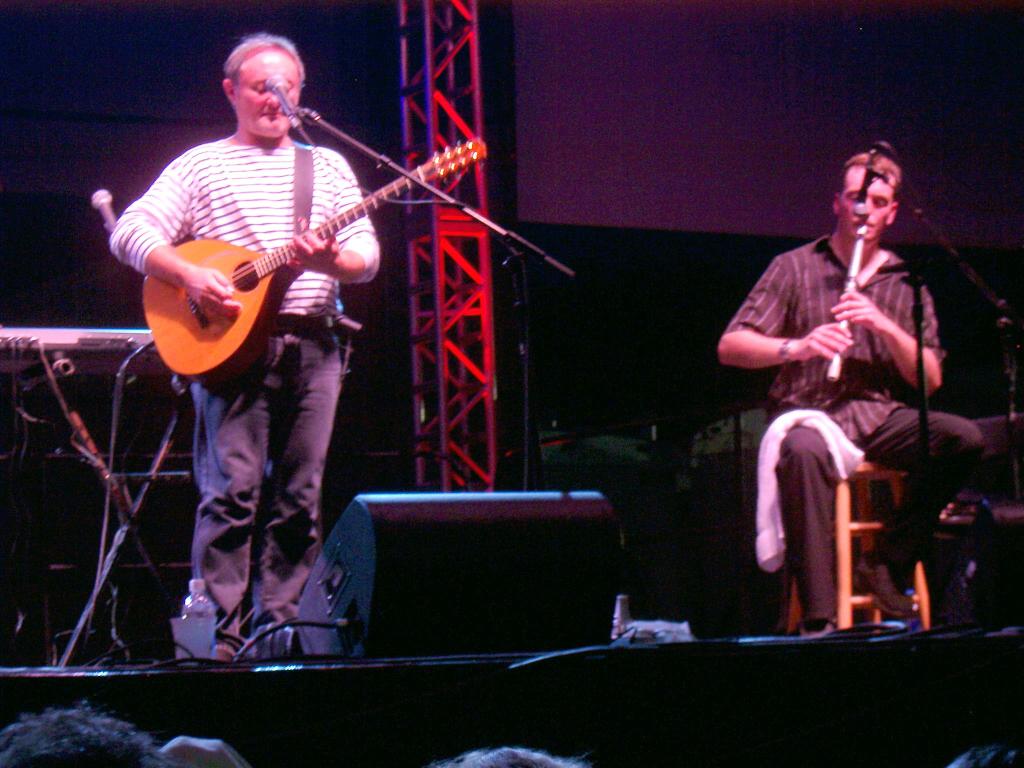
The Kells performing at the 2005 Dublin Irish Festival. That's Brian McCoy, who taught the festival whistle workshops on the right. I only got to see about half of their performance since it was getting close to the end of the day and my three-year-old daughter was ready to leave. The Kells play energetic, traditional music; you can hear it here.

Monday, August 22, 2005

Interviews: Colin Melville

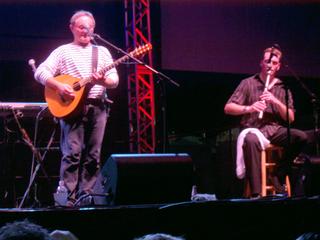
Colin Melville has played Highland pipes, Scottish smallpipes, and whistles for the Tannahill Weavers for five years. I spoke to Colin after their Saturday evening show at the 2005 Dublin Irish Festival.

The tape of the interview is quite noisy, so any errors in transcription are of course mine.

Learning to Whistle: Do you think there's any such thing as a "Scottish whistling style" (as opposed to repertoire), or is whistling pretty much wistling?
Colin Melville: I think the actual method of playing is pretty much the same for everybody. I think when you talk about Irish style or Scottish style or whatever else it's more with the material you're playing, and playing style is probably more down to the individual than the country you're from, I guess.

LTW: It does seem to be fairly common that a lot of Scottish whistlers are also pipers. How does piping affect your whistling?
CM: Well, obviously you use your fingers, so that's similar, but you know the scale is completely different. Obviously, with the bagpipes you've only got nine notes to deal with (obviously have a lot more on the whistle) and you have to learn a lot of new decorations. That's probably the toughest part, for a piper to change their decorations. When you first pick [the whistle] up you try and do the same things, but you have to start using tonguing and stuff like that. It's a different discipline.

LTW: How do you rehearse a tune where you use pipes and whistle at the same time? ...There's such a difference in volume...
CM: When we practice with the band — well, most practices — I usually use the [Scottish] smallpipes, in place of the Highland pipes just for that reason, in spite of the fact that it makes for a color difference acoustically. Other people can hear what they're practicing as well!

LTW: I've read that when you play the whistle and the Highland pipes together you use an E♭ whistle, but it looked like Phil was playing an A whistle tonight?
CM: No, everything we use in the band is all — well, because of the pipes being in B♭ — is tuned around that. There are capos on the guitar and the bouzouki, and the fiddle is tuned up. All the whistles and flutes are E♭ or B♭. The one which looked like A, that'd be a B♭, and then you've got the high E♭ and the low E♭s.
LTW: Right, because [the Highland pipes, which play a tone closer to B♭ when an A is fingered] are not concert pitch....
CM: Yeah.

LTW: In terms of playing the whistle, who are your favorite artists to listen to for performance ideas?
CM: I'd have to say Brian Finnegan. He's a star. I can't get my head around some of the stuff he does with it sometimes. With Flook, his band; they're great. You know, there's so many up-and-coming guys that play, a lot of them pipers... they're getting into different instruments. Findlay Napier (of Back of the Moon), I heard him recently playing the flute... absolutely fantastic. Finlay MacDonald, a great piper, he's also really good on the whistle especially.

LTW: Let's say you like to listen to Scottish music and you want to learn to play it; is there a "short list" of "core tunes" you might want to start with...? I'm not saying you need to list the tunes, but where would you look to begin with?
CM: It's kind of funny, when you go around Scotland, to different parts of the country, if you go down to sessions or if you play with local musicians, you do find that small regions have a set, "core tunes," but when you go to different regions there are different "core tunes." There are obviously some that transcend, but everybody has a set of tunes that they can easily play together. But it's funny, when you go to a different side of the country it's a different set of tunes. And that's the way that you find them. Most people, to find them, go to sessions, play with other guys, and you hear them all the time. I wouldn't say there are specific books or recordings that have got just these tunes in them....
LTW: ...because I look at the Tannahill Weavers and there are a lot of tunes which interest me, but you guys have [14] CDs, and...
CM: Yeah, where do you start? Funny enough, a lot of tunes that the Tannahills recorded way, way back, they're now very popular tunes, whereas when they recorded them they were unheard of.

LTW: I was trying to learn Tranent Muir by ear from your recording and play it on the whistle and I kept needing to go into the third octave....
CM: Very often you just make something up which sounds OK. The songs do tend to go way out, further than a whistle can, definately further than the pipes can. So you very often find yourself trying to stick as much as you can to the melody line but when it goes way above or below you just have to make something up!

LTW: You do [onstage] some fairly impressive feats of instrument changes [e.g., going from the whistle to the smallpipes to the Highland pipes, which requires strapping and unstrapping the smallpipe bellows]....
CM: [Laughs.] Not for the first time I've been caught out a few times — everyone's staring at me, and I'm... "What's wrong?" I'm supposed to be playing the smallpipes or something and I'm just standing there.

LTW: I know you guys recorded a tune from a Scottish whistle tutor. But I haven't seen that book in the U.S. Have you ever seen a whistle tutorial with Scottish music that you liked?
CM: To be honest, I kind of learned through sessions, and bands playing along. When I started playing folk music I was a piper, and I thought, I've only got a few sets [for the pipes]; I'd be sitting there the rest of the night, and I thought, I'm going to have to do something here. So that's how I started playing the whistle. Kind of unconventional roots. I have come across a few tutorial books over the years and they're varied in quality. You know, everyone has at least something that teaches you something new, so it may just be best to go out and buy a few of them, if you can find a few kind of cheap ones, then you pick up lots of little bits and pieces....
LTW: Can you tell me about the whistles you play; who makes them and what do you like about them?
CM: The low whistle I play is a Chieftan. I've been playing a low D Chieftan for a long, long time, and when I joined the band I just naturally got an E♭, because I'm just so comfortable with it. I recently ordered a set of high whistles from a guy called Chris Abell, from North Carolina. So you get the same head with the E♭, the D, and C bodies, and I just think they're wonderful. I just got them a couple months ago, and you can really hear them coming in now; they're starting to get "played in." They're just a joy to play. I definately recommend them. We also use the cheap ones; the B♭ one we use is just the Generation. You have to go through a box of them; you have to find a "good one," to spend time going through them.

LTW: How do you orchestrate a tune, decide which instruments you're going to put to it? Is it trial and error or...?
CM: Trial and error to a certain extent. There's a format we use very often on stage. You know, you're not going to put the bagpipes in at the start and play the small whistle at the end because of the power of the bagpipes. You should put them at the end if you're going to put them in a song; you get that blast. As far as choosing my instruments, trying to decide whether to play the whistle with the smallpipes, or the high whistle with the smallpipes, that part usually depends on what Phil is doing, if he's playing the flute and whistle as well. Two whistles together sound lovely; you can throw lovely harmonies in. But if I'm playing smallpipes and he's playing whistle it gives you more freedoms; you can mess up and get away with it! With the same instrument you notice every little — if somebody does something slightly different you can hear it. When playing different instruments it gives you a little bit more of a free reign with what you're doing. So that's something to barter.

LTW: What's it like to join a band that has three decades of history behind it before you came on?
CM: Yeah, it's pretty weird. It's pretty weird. It's great, you know. I was just handed this opportunity... Do you want to join the Tannahill Weavers? "Hmmm... Let me think about that..." [Laughs] Well now I've put in five years and I'm quite comfortable with it. At the start it was quite, quite daunting.
LTW: Did you have to study all their old material, to pick up the tunes?
CM: Yeah, yeah. I knew the piper who was before me in the band; he was very helpful with it. It made things a lot easier because he spent a lot of time going through the material with me. In the first gig — actually, I just remembered that — the first gig I did with them was in Germany, and I only met Roy the afternoon of that gig; it was the first time I'd met him. [Ed. note: Roy lives in the Netherlands.] Up until then we'd just been practicing to tapes and things. That was pretty weird. I was pretty nervous about it, but it all went well I think. I'm still with them so I must be doing something OK.
LTW: It seems like you're doing quite a lot. You're not just piping; you're involved in the production and [writing] the music....
CM: Yeah; that's a really good opportunity for me because the band records — well, we usually do it on our own — so we do a lot of the recording and then there's a sound engineer who comes in and helps us with it. Because if you're in a commercial studio you're really pushed for time; it's all money, money, money. But because we have our own little place we can sit and take our time, follow our ideas and mess about with things.

LTW: Roy told me that you guys never perform The Great Ships live, and I'm curious: Are there songs that just can't be done live, or...?
CM: Yeah, there are some songs that are more difficult to come up with a live arrangement. Just for an example there are a lot of songs and tunes that John plays cello and viola — all sorts of "stringy things!" — and he can't do that live and some things that there'll be a kind of technical part in the arrangment and that becomes a lot more difficult. You have to come up with a new arrangement basically to do that live. We like to do things live pretty much the way they are on the CD.

LTW: Do you have any good stories from your tour?
CM: [Laughs] Uhhh.....
LTW: ...any you're willing to repeat?
CM: Yeah, exactly! Here's a funny one: Coming through customs, coming into the country, just last weekend. John the fiddler, he came up to the guy; you know, you get a little interview. The guy says, "What are you doing here?"
"I play in a band."
[The customs inspector asked] what kind of band, what kind of music do you play, what instrument, and all that, and they're chattin' away, and [the inspector] is writing on this form, and he looked at John, and said, "So, your occupation would be...?"
John said, "Musician."
[The inspector] went to write it and he looked up at John and said, "Umm... I'll just write fiddle player; it's easier to spell."
It's true! Incredible, but true.
That will get me in trouble; I'll get pulled aside on my way out of the country!