For me, learning how to breathe without breaking the rhythm of a tune is not easy. I've written about this before, but in the months since I wrote that post I've changed my conclusions.
Breathing as Ornamentation
I've explicitly discarded an assumption which I didn't write about at the time and might not even have been conscious of when I wrote the previous post. As a beginner, my instinct was to try and make breaths as inconspicuous as possible. The trouble with that notion is that "as inconspicuous as possible" is still pretty conspicuous!
I don't think there's any way to play a quick tune (or at least most tunes) in such a way that the listener can't tell when you breathe. Certainly, it isn't difficult for me to hear very good whistlers taking breaths when I listen to CDs. Circular breathing is for didgeridoos. So if we accept that there will always be an audible gap in the music when we breathe (unlike, say, the fiddle or the pipes), then instead of hiding the gap in the tune altogether we must make the gap appropriate for the tune. Turning lemons into lemonade, as it were. A well-placed gap for a breath, in other words, is an ornament, a variation in the tune which adds musical interest.
One good way to learn about using this form of ornamentation is to listen to recordings of Irish music on the flute. Flutes require a lot more air than (soprano) whistles, so the players have to breathe more. Hence, you have a lot more opportunities to listen for this in a flute passage.
There's an ornament I've always liked that I hear most prominently on flute recordings, but you can hear in whistle recordings as well, where a player shortens a note and skips one or two notes which follow. I'm embarassed to say that it didn't occur to me until recently that this was not merely done for style but that the player was breathing as well! In case it's not clear what I'm referring to, consider the following two score fragments:
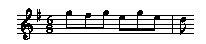
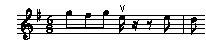
The first score is an unornamented bit of a tune. Although notating ornamentations is an approximation at best, I've attempted to express in the second version what I'm hearing on the recordings — a note is shortened but emphasized, the following note is gone altogether, and then the tune picks up after a rest.
If you're following along at home, now would be a good time to put on your favorite Irish flute CD, as it will probably give you a better impression of what I'm discussing than my clunky notation above.
An Ornamentation Approach to Learning to Breathe
Well, it's all fine and good to assert that breathing is an ornament, but it doesn't make it any easier to do, does it? After all, I can choose not to practice rolls until I get the fundamental rhythm of a tune right, but I can't choose not to breathe. It's a difficult thing, biology.
But maybe it does help. Because it suggests that what I said I found helpful last time:
So here's something which may seem obvious to folks who have played for a while, but took me a bit to realize: You can continue to finger the note as usual even though you don't blow it while you breathe. This way you're not disrupting the normal movement of your fingers during the breath.
...is profoundly wrong. There's a nugget of truth in what I wrote, I think: The reason I was losing the rhythm was that what was going through my head and what I was doing physically were different. But I picked the wrong solution. Instead of attempting to avoid changing what I was doing — and as I noted above, you can't avoid breathing — I should have been trying to change what I expected to play. I can play a tune better when I have an expressive version in my head.
It's not a magic bullet, though. I can do this well when I'm playing quite slowly, or if I practice breathing in a particular passage, but it's going to take some practice to be able to do it at will when playing quickly.
Conclusions
So the lengthy post above boils down to this:
- I find it valuable to listen to good flutists on CD, and pay attention to their "breathing ornaments." I'm trying to get this ingrained in my head.
- When I'm playing a tune and I need to breathe, I try and imagine the sound of the notes I'm about to play with this ornament. It make it easier to execute.
- When I do this, I no longer get confused by not fingering the notes I drop. In fact, trying to finger them is confusing. It suggests I'm playing the tune mindfully instead of from muscle memory.


 ). O'Donnell plays it together with The Blackthorn Stick; the two sound great together. This one is hard for me to play on the flute since it goes from first-octave A to low D to second-octave E, necessitating changes in embouchure.
 as Frieze Britches (where it's incorrectly identified as a slip jig in the liner notes, which confused me for some time when I first bought the album!), but his version is too fast/complicated for me to keep up with, though very nice for pure listening! Bingham's recording is slower and less heavily improvised. Liam O'Flynn plays it on

